

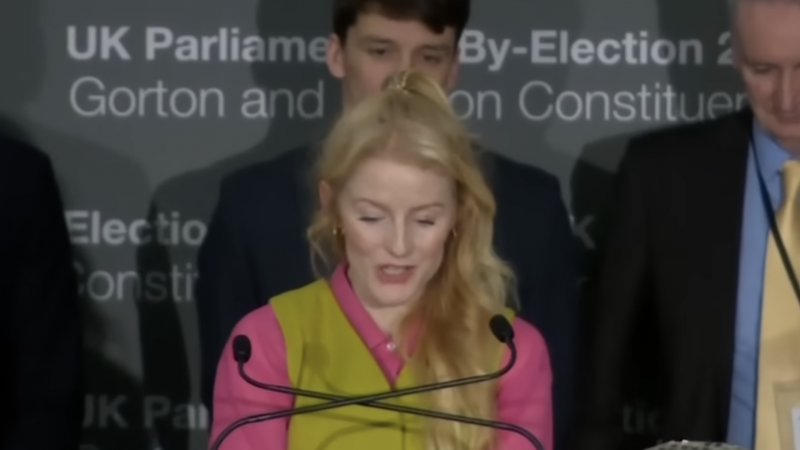

The past has a funny way of crystallising in our memory. Hotly contested elections, with campaign strategies ranging from the convivial to the vituperative, become seen as inevitable, unstoppable outcomes. The resources pumped into delivering those final results are quickly forgotten about. However, in light of Survation’s post-by-election polling, it is clear that Gorton and Denton was anything but a foregone conclusion. Until the bitter end, this was a back-and-forth battle between the Greens and Labour. For the former, a chance to win a seat that ranked 127th in their 2029 target list. For the latter, an existential test of the party’s overall direction. In the background, Reform UK was a steady counterweight, primed to nick the seat if neither of the contenders gained a clear advantage over the other.
The crucial last two weeks – unless you were Matt Goodwin
Survation’s poll on behalf of Datapraxis showed that just over half (53%) of voters in Gorton and Denton decided who they would vote for in the final two weeks of the campaign, including almost a fifth (19%) who decided in the final few days before polling stations opened. This pattern was most pronounced amongst Labour and Green Party voters, with approximately 18% of Angeliki Stogia’s supporters only deciding on the day of the election. It would appear, then, that the haemorrhaging of Labour support occurred gradually throughout the campaign. The dam did not burst all at once; rather, Labour bled out over a month.
READ MORE: A gory night for Labour
This stands in marked contrast to backers of Reform UK’s Matt Goodwin, 60% of whom decided to vote for the candidate as soon as the election was announced, or soon after. The same was true for just 37% of Labour’s eventual voters, though the Greens sat on a healthier 44%. Goodwin, therefore, had the bulk of his support from the beginning; whereas Stogia and Spencer were locked in a situation where every vote, until the very end, was contestable. If the Greens had not achieved a decisive lead over Labour, there would have been a credible path to victory for Reform thanks to a split progressive vote.
Floating minds for non-Reform voters
With voters’ decisions not made until the latter half of the campaigning period, often in the final few days, we can also observe the candidates they were considering during this time. We found that two-fifths (41%) of Labour voters considered voting for Spencer at one point, whilst over a third (36%) of Greens considered voting for Stogia. Voter allegiances are subject to natural vagaries at the best of times, but in Gorton and Denton they took on a truly ephemeral character.
However, the same could not be said of Reform UK voters, with Matt Goodwin again representing the steadier ship amongst the three main candidates in this election. Seven in ten (70%) of those who voted for Goodwin did not consider alternative candidates, compared to 53% who voted for Spencer and 45% who went with Stogia. Reform UK’s base made up their minds earlier and remained unwavering in their support of their candidate, making them a consistent and real threat throughout the campaign as progressives ummed and ahhed.
The Burnham effect
Had Andy Burnham been allowed to stand in the election, our data suggests he would have calmed choppy waters, bringing certainty into a by-election filled with doubts and possibilities. Overall, 47% would have voted Labour had he stood, reducing Spencer to a 25% vote share and Goodwin to 21%.
With little over a third of 2024 Labour voters staying with the party in Gorton and Denton, if Burnham had been the candidate we estimate that almost two-thirds (65%) would have voted Labour once again. Amongst other groups, he would have taken over two-fifths (43%) of those who voted for Spencer in the by-election and even almost a fifth (17%) of Goodwin’s voters – an impressive feat considering that just 4% of his eventual supporters considered voting for Stogia during the actual campaign.
Subscribe here to our daily newsletter roundup of Labour news, analysis and comment– and follow us on TikTok, Bluesky, WhatsApp, X and Facebook.
The decision to block Burnham from standing in the by-election was obviously catastrophic for Labour. An overlooked point is that it also placed progressives in a precarious position. By splitting the vote, the threat of a Reform UK victory crept closer to becoming a reality.
Labour’s by-election problem
Incumbents, of course, rarely fare well in by-elections. But Labour cannot ignore the fact that this is the second Westminster by-election where they have lost a seat that, in just 2024, they held onto 50% or more of the vote. Not only that, it is the second by-election where they have lost out to insurgent parties, firstly from the right and now from the left. The decision to block Andy Burnham potentially instilled in voters’ minds an image of a party that was no longer willing to stand for anything, preferring to put internal, Westminster-oriented politics first.
In the end, non-Reform voters had a tough choice to make between Stogia and Spencer, one which they debated at length over the election campaign. Labour failed to unite the progressive vote, handing the Green Party their fifth member of Parliament. In doing so, Labour came dangerously close to leaving the door open for a steadfast Reform UK voter bloc waiting in the wings.
The Labour leadership would be wise not to make this mistake again.
Share your thoughts. Contribute on this story or tell your own by writing to our Editor. The best letters every week will be published on the site. Find out how to get your letter published.
-
- SHARE: If you have anything to share that we should be looking into or publishing about this story – or any other topic involving Labour– contact us (strictly anonymously if you wish) at [email protected].
- SUBSCRIBE: Sign up to LabourList’s morning email here for the best briefing on everything Labour, every weekday morning.
- DONATE: If you value our work, please chip in a few pounds a week and become one of our supporters, helping sustain and expand our coverage.
- PARTNER: If you or your organisation might be interested in partnering with us on sponsored events or projects, email [email protected].
- ADVERTISE: If your organisation would like to advertise or run sponsored pieces on LabourList‘s daily newsletter or website, contact our exclusive ad partners Total Politics at [email protected].



More from LabourList
‘Don’t do it as a protest vote’: Can Labour survive a green wave in Cambridge?
‘France’s municipal elections are a warning Labour cannot ignore’
Wes Streeting dominates airwaves on morning broadcast rounds in first months of 2026