

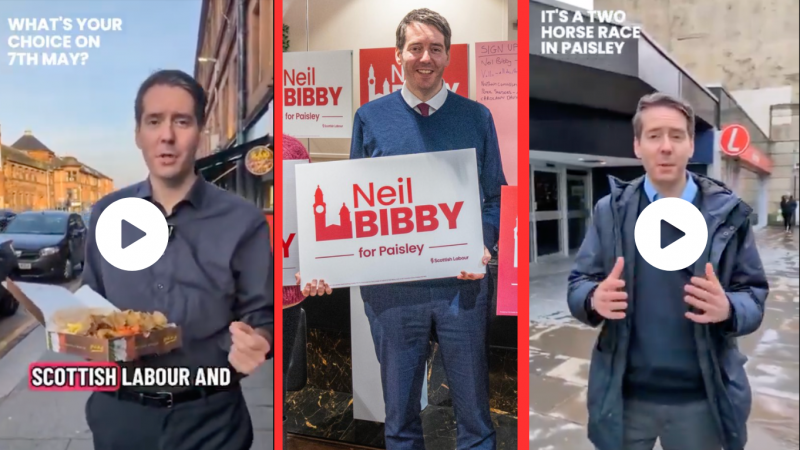

As LabourList visited Scotland to report on the upcoming Holyrood elections, Paisley candidate Neil Bibby was a priority for us to find time to sit down with. We wanted to discuss his approach to communication alongside his experience of the Scottish Labour campaign to try and oust the SNP from power. We met him in a local cafe in Paisley’s town centre, he was dressed in a suit with his Scottish Labour sticker worn proudly on the lapel. Neil would be going straight from our conversation to the doorsteps to canvas – the first of four sessions he is holding every day.
It became immediately apparent that Neil is an incredibly dedicated candidate who understands the need for an effective communication strategy. He acknowledged a general apathy for politics at present, with many voters disillusioned and claiming to have not spent much time thinking about the upcoming election. He pointed out that while a Scottish election had been scheduled for some time, “it’s only in the last couple of weeks that it’s really… resonated with people.”
“I think…that moment when the polling cards go out and people realise ‘there’s an election on’ that’s when people have started to really think about their choice in May.”
READ MORE: ‘It’s going to be all about ground game’: Paul Sweeney on Scottish Labour’s fight for Glasgow
This is a narrative we found repeated across Scotland, with many Labour activists and candidates predicting the upcoming election may see a drop in voter turnout at the ballot box.
Scottish Labour released their manifesto on Monday 13th April, less than four weeks away from polling day. Perhaps this was to ensure their policies could be discussed across the time when people were beginning to pay attention.
What did he think had caused such disillusion with the political system in Scotland going into this election?
“I think there’s a sense of people paying more and more and getting less and less.” This answer remains consistent with the language Scottish Labour leader Anas Sarwar uses to describe the situation Scotland finds itself in, when speaking in the leadership debate held in Paisley on Sunday 12th April.
Both say that responsibility ultimately lies with the SNP. “After 20 years” Neil said the SNP have shown a “failure to get the basics right.”
Bibby described the SNP as having a “huge budget” but had failed to utilise it, creating significant amounts of “waste” that Scottish Labour would need to clear up if elected.
Examples he discussed included the “ferries fiasco”, where Neil pointed out that “hundreds and hundreds of millions of pounds getting spent on ferries that don’t sail.” This was not solely an issue for the islanders who lost out on connectivity with the mainland. “Everybody in Scotland is paying the cost… taxpayers here are footing the bill.”
He also pointed to the size of the Scottish civil service, arguing “for a population of over 5 million, we’ve got more quangos and agencies, and we have MSPs!”
The SNP record leaves a lot to be desired. Bibby feels this is a result of the separatist party being more focused on constitutional issues than running the country effectively. “We’ve got a party in government that has been obsessed with issues outside its control.”
The issue of independence has become a key talking point for the SNP again entering this election. When asked if this was coming up on the doorstep, Bibby noted that it is not a dominant issue for many voters. “Some people… it does come up… but… people have got other things to deal with.” He also suggested that the SNP’s record weakens its argument: “It almost became a barrier to independence… because people see the issues… in public services.”
While Bibby could articulate how the SNP were responsible for many issues the Scottish electorate faced, how did he perceive the voters felt towards them? “There’s definitely a sense in Paisley… after 20 years of the SNP… there is time for a change.”
He continued to set out an array of issues that were voters consistently raised on the doorstep. Cost of living was a regular talking point with the electorate desperate for the government to provide some relief.
Housing shortages were also raised in relation to broader social concerns. “We’ve got a housing emergency in Scotland, we don’t have enough homes,” he told us before adding that Scottish Labour have a policy to tackle this: “We’ve promised to build 125,000 more homes over the next five years.”
Local conditions, such as street cleanliness and road maintenance, were described as highly visible indicators of poor government performance that led to voter dissatisfaction. “The very first interaction that you have… is when you step outside your door.”
He stressed the importance of delivering quickly on visible improvements if Scottish Labour were to win the election. “If you can clean them up… it’s one of those immediate impact opportunities to say things are getting better.”
Infrastructure gaps were also highlighted, particularly transport links “You can get a train from Glasgow Central to Manchester… but you can’t get a train from Glasgow Central to Glasgow Airport.” An improvement to infrastructure “would be the biggest shot in the arm for the local economy” he explained as it would open up more job opportunities for people in Paisley.
The most prevalent issue for Scottish voters though was, by far, the NHS – particularly around access and waiting times with many reporting they struggle to get a GP appointment or operation when they need them in Scotland. He provided a specific example from a constituent. “I’m not voting SNP because… they cost me 7 grand” he explaind “he had to go private for cataracts operations.”
The MSP outlined Scottish Labour’s focus on core public services offering a realistic approach to government. The message was simple: “We want to get the basics right.”
Become a friend of LabourList and join our community. Our friends support our vital non-factional work and get access to exclusive content and events.
He was also careful to suggest that Scottish Labour should not suggest they can over-promise and risk further alienation of voters. “We’re not going to promise… to fix absolutely everything,” he explained it would be unrealistic to suggest this. But recognised that in improving the public services that people interact with on a daily basis, Scottish Labour could provide the hopeful feeling of change the country needed.
We moved on to discuss his social media strategy (something he has become known for), with Neil explaining both how he thought of ideas and why he chose to promote his campaign in this way. He explained that his videos were designed to be relatable as a means of “making politics more accessible”.
With so many people generally uninterested in politics, he recognised how difficult it was to battle for attention on heavily saturated social media platforms. His videos were designed to break through this. “You need to try and get a message across… in a way that draws people in.”
“Things like football… going to a takeaway… are relatable experiences.”
Through hooking people with something they found familiar, he could swiftly pivot into discussing the key lines he wanted them to come away with. Bibby explained that this was also having an effect, with him finding that his local profile has increased in Paisley since he started making this content. We asked the waitress at the cafe if she had seen Neil’s videos, she immediately referencing his ‘keepy-ups’ football video.
As we discussed this at length, Neil treated LabourList to an exclusive viewing of the video he had planned for the weekend (now posted to his social media channels) revolving around the grand national. Again he uses a topical talking point that will pick up traction to squeeze in his message of a ‘two-horse race’ between Scottish Labour and the SNP.
While engaging content is important, he also made sure to stress the need for them not to venture into ‘political stunts’, which many have accused the likes of Liberal Democrat leader Sir Ed Davey of relying on.
For the Paisley candidate, the message is much more important than the ‘bit’. Whatever concept he has chosen to focus his video around is solely there to hook the viewer, buying him enough time to divert their attention to the message he wishes to get through. Most often in this case, the message is that only Scottish Labour can defeat the SNP.
He was also firm on the necessity for content to be authentic, suggesting that if it wasn’t it simply would not work.
Bibby traces his political values to his upbringing, most notably due to his parents roles as social workers. He described this as providing him with “values around equality and fairness.” As a result his motivation in politics is rooted in public service and his connection to the local area, which he feels is central to his candidacy: “I live in the town… I use the same services as you.”
When asked his favourite thing about the place he wants to represent, there was no hesitation in his response.
“The people of Paisley… there’s a community spirit… a solidarity.”
As the end of our time with the candidate who had a day of conversations with the community ahead of him, he returned us to the sense of pragmatic realism that remains central to his approach.
“I can’t promise to fix everything… but I’ll always promise to try my best.”
We finished our interview by asking for a book recommendation from Neil. He recommends The Political Brain by Drew Weston for LabourList readers.
Subscribe here to our daily newsletter roundup of Labour news, analysis and comment– and follow us on TikTok, Bluesky, WhatsApp, X and Facebook. You can also write to our editor to share your thoughts on our stories and share your own. The best letters are published every Sunday.



More from LabourList
Good growth in every postcode 21st October 2026
‘Labour must put culture at the heart of their youth mental health plan’
‘The Thames Valley is driving growth. Devolution can turbocharge it.’