

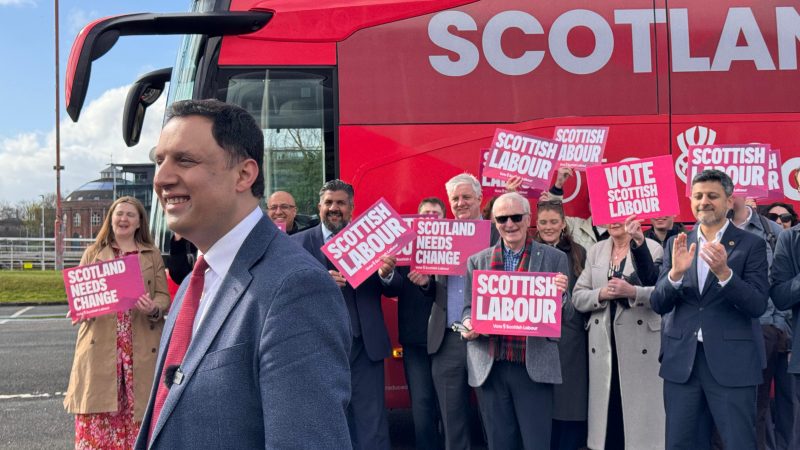

Just under three weeks remain until the Scottish electorate head to the polls. LabourList sent Myself and Daniel Green to Scotland’s central belt to take a closer look at Scottish Labour’s campaign. Polling suggests the party is facing a significant challenge, as it looks to convince the public that they, under leader Anas Sarwar, should take control of the Scottish Parliament.
The biggest hurdle is one the party has failed to clear over the last twenty years – ousting the SNP from government. Many report voter dissatisfaction with the separatist incumbents heading into this election. This comes as a result of a struggling NHS and rundown public services under their watch, alongside public scandals that First Minister John Swinney’s party have struggled to manage.
The combination of these factors have prompted Scottish Labour to conclude that now is the time to go all in. “Only Labour can beat the SNP” has been the central message, even if it requires “holding your nose” while you vote for them.
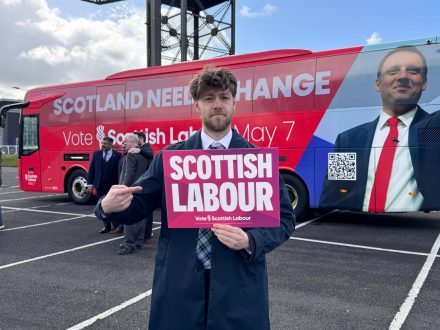
Across LabourList’s week in Scotland, we met with candidates standing in Edinburgh, Glasgow, Paisley and Rutherglen, in addition to Scottish Labour activists who were hitting the doors daily and engaging with voters. While there, Scottish Labour publicised their campaign broadcast video which received significant support online. We also managed to catch the Scottish Labour battle bus as it began its tour of the nation, meeting leader Anas Sarwar in the process.
Any confidence evidenced by Scottish Labour candidates is not rooted in any belief that the campaign has been easy.
In almost every conversation, candidates acknowledged the difficult reality that Labour is trying to fight a Holyrood election while the UK Labour government in Westminster remains unpopular with Scottish voters. On the doorstep, activists told LabourList they were regularly hearing frustration with Westminster, with some voters still unsure whether Scottish Labour could truly chart its own course. But rather than shy away from that, the party appears to have built its campaign around confronting it directly.
READ MORE: ‘It’s going to be all about ground game’: Paul Sweeney on Scottish Labour’s fight for Glasgow
Anas Sarwar’s decision in February to call for the Prime Minister’s resignation was always going to be a significant talking point. When asking activists about this, we were told that overall they felt it had been beneficial on the doorsteps. If ever anyone raised concerns about Labour that related to the Westminster government rather than the Scottish party, candidates in Scotland had a clear point of separation.
Again and again, they could return to the same line: this election is about who governs Scotland, not who governs in London. As Keir Starmer again struggles with the fallout over his decision to appoint Peter Mandelson as US ambassador, Scottish Labour candidates can feel there is a distance between Westminster and Holyrood they have created that will hopefullu prevent them being tarred with the same brush.
When we interviewed Scottish Fabians director and candidate in Edinburgh Eastern Musselburgh and Tranent, Katherine Sangster she put it to us well.
“I can say it’s not Keir who’s standing here, it’s me. It’s me on the leaflet, who lives in this constituency. It’s me that’s going to be working hard as your MSP. Your vote is not going to get rid of Keir. Anas has helped us have that conversation.”
Sarwar described his decision as one to “put Scotland first” – an approach that has shaped how Scottish Labour are campaigning. Voters are being told they do not need to love Labour to back them, only to decide whether they are prepared to give the SNP another five years in office. When on the doorstep, we saw for ourselves the lack of love for the SNP.
Scottish Labour has put the emphasis less on ideology or the constitution, as the SNP would like it to be, and more on competence. The party is looking to win on the promise of fixing waiting lists, improving schools, repairing roads and restoring trust in government. Candidates spoke less about making constitutional arguments and more about “getting the basics right”, and doing so quickly. The party has drawn up plans to repurpose spending commitments made in the current Scottish parliamentary budget, redirecting funds toward tackling some of the most pressing issues voters interact with on a daily basis.
However, the confidence Scottish Labour projects to the public, feels much more cautious internally.
Few can dismiss the polling, which continues to place Scottish Labour in a particularly unclear positon when interpreting predicted results. The party could find itself in a position whereby it becomes the official opposition in the Scottish Parliamentary chamber. However, it may also lose MPs in the process. Whether this will be interpreted as a success or failure for Sarwar will only be decided in the post-election analysis once results are confirmed.
Communication strategies were also a significant talking point between LabourList and candidates while in Scotland. It was reported several times when speaking with candidates that many voters had not paid much attention to the fact there was an election on – leading some party insiders to question the effectiveness of their comms. When speaking with Daniel Johnson MSP in Edinburgh, we discussed the extent to which this was an issue with Scottish Labour communication, or rather a result from general voter distrust in politics all together, which he described as at “rock bottom”.
Become a friend of LabourList and join our community. Our friends support our vital non-factional work and get access to exclusive content and events.
We heard a similar story when speaking to Monica Lennon MSP in Rutherglen. She explained: “I was speaking to a gentleman and he thought it was a UK election. These conversations are happening up and down the country – and it’s not that people don’t understand, but people are busy working hard, feeling like they’re getting less.” Scottish Labour, if they were to form the opposition, would have to push even further to get their message across to the voters after 19 years in opposition.
It would be unfair to suggest that comms was a universal issue for the party though, as we found in our visit to meet with Neil Bibby MSP in Paisley. Through Neil’s interview we uncovered the way digital campaigning had helped candidates like him push the squeeze narrative that only Labour could defeat the SNP.
Throughout our trip, we discussed the polling figures with several candidates. Across these conversations, there remains a clear sense that the published numbers may not fully capture the mood they believe exists on the ground. Several candidates pointed to what they described as a growing softness in former SNP voters, particularly among those frustrated by public services and exhausted by nearly two decades of the same administration. As Glasgow MSP candidate Paul Sweeney put it to us:
“There is a real sense [that after] 20 years of SNP rule people are really scunnered with them. There’s certainly challenges when it comes to the UK Labour Party. We all know about the difficulties there, but honestly, there’s no love for the SNP. People are actually yearning to get rid of them.”
Subscribe here to our daily newsletter roundup of Labour news, analysis and comment– and follow us on TikTok, Bluesky, WhatsApp, X and Facebook. You can also write to our editor to share your thoughts on our stories and share your own. The best letters are published every Sunday.
The argument from Labour is not that victory is certain, but that the race is tighter than many outside the campaign assume. There is certainly a belief that after nearly twenty years of SNP government, some voters may finally be ready for a much-needed change.
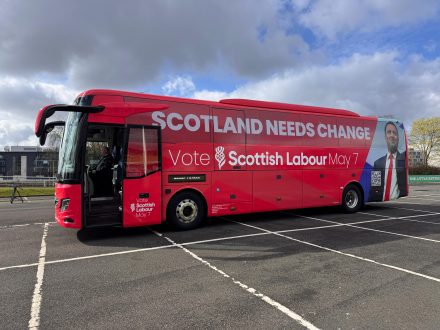
To finish our trip, we met leader Anas Sarwar at the launch of the Scottish Labour battle bus. Speaking to LabourList he explained clearly the stakes of this election to help motivate Scottish Labour members who continue knocking on the doors and fighting for the change Scotland needs.
“We have the opportunity for the first time in a generation to change the government here in Scotland. After 20 years, every single person across this country knows that Scotland needs change – and the argument we have to make in demonstrating that over the course of the next four weeks is that only Scottish Labour can deliver.
“In the vast majority of constituencies in this country, it is a straight choice between Labour and the SNP.
“If you want to fix our NHS, if you want to guarantee opportunities for our amazing young people, if you want to build 125,000 new homes so we can drive down homelessness and eradicate rough sleeping once and for all, if you want safer streets and stronger communities, and if you want to end the waste, get the basics right and cut taxes in this country, you’ve got to back Scottish Labour.”
Ultimately when visiting Scotland, LabourList found a campaign building on what opportunity it has. After years of falling short, the party believes this may be the first election in a generation where simply asking whether Scotland can afford more of the same could be enough to make voters pause. With just weeks remaining, Scottish Labour are campaigning like a party that knows the odds remain difficult, but one that believes there is some chance that those odds can still be beaten.



More from LabourList
‘Arts for young people is key to hope’
‘It’s time to end the university-first approach to opportunity’
‘The government must reform vehicle taxation in the next budget – or risk losing out on more than £60 billion’