

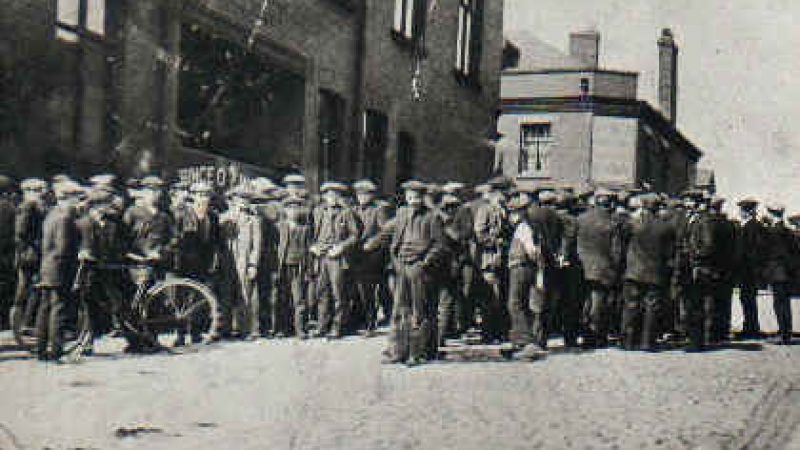

The General Strike – whose centenary is now upon us – is one of those beautiful messes which litters the history of the British labour movement.
If the passage of time has seen the strike become obscured by contesting mythologies, even at the time it provoked bitter differences of sectarian interpretation regarding what it said about the character of the working class, their trade unions and the Labour Party as well as how best to achieve political change.
A general strike had long been seen by revolutionaries across Europe as a means of bringing down capitalism. The idea however had little appeal to Britain’s union leaders who had carved out an influential place in society through negotiation and even helped create the Labour Party to help them advance their interests through legislation.
\So, it was remarkable when the General Council of the Trades Union Congress called for a General Strike to begin on May 3rd 1926. Their intention however was not to end capitalism but to support the Miners’ Federation of Great Britain’s attempt to resist pay cuts and increases in the working day. Coal mining was then a critical part of the economy, employing 1.2 million workers. Badly run by private mine owners – one index of which was a horrendous rate of injury and death – increased foreign competition after World War One led to overproduction. In response the owners sought to protect their profits by squeezing workers’ pay and conditions. In the face of this attack the miners had already gone on strike five years before but were defeated.
READ MORE: ‘Organised labour has transformed the world of work for the better’
Given its importance, post-war governments of different colours appointed two Royal Commissions to find a way of solving the industry’s problems; but while many recognised the need for change no consensus was reached. Labour even entered the 1923 general election calling for the mines’ nationalisation but the minority status of the brief Ramsay MacDonald government which followed meant this remained a paper commitment, one vigorously opposed by the Liberals and Conservatives.
Despite its name this was not a completely ‘general’ strike. The TUC limited its call to those in particularly influential sectors, notably heavy industries like iron and steel, as well as transport and printing. As many as three million answered the call, including some not asked to join the strike, despite some employers threatening retribution to those that did.
If the significance of this response remains debateable, it is likely most went on strike because of a shared and visceral working-class identity, and to show solidarity with the most hard-pressed members of that class. They demanded recognition and respect – but within the existing capitalist society. A minority of participants believed the strike could develop into something revolutionary: the left-wing Labour MP Ellen Wilkinson’s 1929 novel Clash gives a vivid account of this sentiment and how radicals responded to it. Wilkinson was nonetheless out of step with her party leader. MacDonald’s electoral strategy was to win office by presenting Labour as willing to represent the whole nation rather than just one class. He feared the strike would associate Labour with extremists and so kept his head down during its course, praying for a quick conclusion.
Certainly, the Conservatives decided to take the strike as what the Daily Mail called ‘a revolutionary move which can only succeed by destroying the government’. It is doubtful Prime Minister Stanley Baldwin saw the matter in such vivid terms but the year before he had begun planning to coordinate food and fuel supplies in case of any disruption and established a force of 30,000 volunteers to replace strikers. This allowed his government to quickly put soldiers and tanks on the streets and promptly mitigate the strike’s effects. Indeed, some suggest Baldwin provoked the TUC into calling the strike confident he could defeat it.
What followed was a muted class war – and nobody knows how things might have developed had the strike continued for longer than it did. For, if generally peaceable (there were instances of strikers and the police playing football matches), the strike’s nine days still saw incidents which led to 9,000 arrests.
Become a friend of LabourList and join our community. Our friends support our vital non-factional work and get access to exclusive content and events.
The TUC hoped a General Strike would encourage Baldwin to lean on the employers to withdraw their attack on the miners. Instead, they faced by an implacable Prime Minister who refused to bend. So having failed to find a negotiated solution of its own the TUC called off the strike, afraid if it continued many unions would be bankrupted thanks to giving their members strike pay and that Conservatives would curtail their legal rights. This left the miners in the lurch, still on strike, and at the end of the year they returned to work to accept those punishing conditions the General Strike was supposed to prevent.
Some on the left still consider a general strike a valuable weapon in the class war. Certainly, historians informed by that perspective have argued that in 1926 it was just the timidity of union and Labour leaders that caused the General Strike to fail. If that massively over-estimates working class revolutionary fervour, few historians mount a vigorous defence for a TUC that called a General Strike with little idea how it might end when opposed by a well-prepared, hostile government. Perhaps the best that might be claimed of the Strike was it revealed the extent of a self-sacrificing working-class consciousness even if it was mobilised by those uncertain what to do with it. If the beautiful mess that was the General Strike achieved anything concrete it was to confirm to union leaders that their cautious course was best in the long-term. MacDonald’s caution was also vindicated when in 1929 Labour formed a second but still minority government.
Indeed, one hundred years after it began the General Strike looks like an awkward deviation from the British labour movement’s ingrained constitutionalism, something that would win its greatest exoneration in 1945 when Labour finally won a general election which enabled it to nationalise the coal industry to the benefit of both nation and miners. Of course, that might not have been much comfort to those miners and their families who had to wait over two decades for this happy outcome, much of that time defined by unnecessary misery and suffering.
Subscribe here to our daily newsletter roundup of Labour news, analysis and comment– and follow us on TikTok, Bluesky, WhatsApp, X and Facebook. You can also write to our editor to share your thoughts on our stories and share your own. The best letters are published every Sunday.
-
- SHARE: If you have anything to share that we should be looking into or publishing about this story – or any other topic involving Labour– contact us (strictly anonymously if you wish) at [email protected].
- SUBSCRIBE: Sign up to LabourList’s morning email here for the best briefing on everything Labour, every weekday morning.
- BECOME A FRIEND: If you enjoyed this, why not consider becoming a Friend of LabourList? Help sustain our journalism, and of course Friends do get benefits…
- PARTNER: If you or your organisation might be interested in partnering with us on sponsored events or projects, email [email protected].
- ADVERTISE: If your organisation would like to advertise or run sponsored pieces on LabourList‘s daily newsletter or website, contact our exclusive ad partners Total Politics at [email protected].



More from LabourList
Rotten to the core? Reform demonstrate why party discipline is important
Paul Nowak column: ‘Britain needs a living standards Budget’
‘Brexit was never a closed matter – it’s time to put the national interest first’