

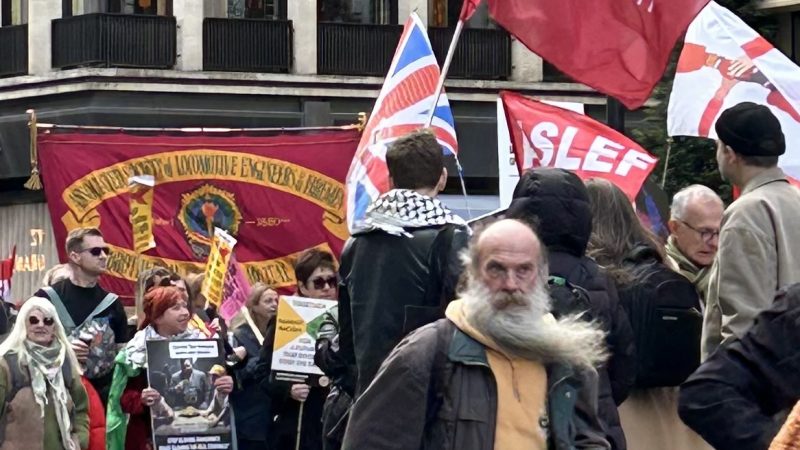

It was the biggest demonstration of working-class “selflessness, loyalty, creativity and resolve” that Britain has ever seen. And it all started at the Daily Mail.
A century ago this week, the paper’s London workers refused to print an editorial urging the public to resist a threatened general strike, which it dubbed “revolutionary”.
A short walk away in Downing Street however, Trades Union Congress negotiators knew nothing of the printers’spontaneous, unofficial walkout. They were hopeful of a last-ditch, late-night settlement for the coal miners at the heart of the dispute, with over a million locked out of mines days earlier for refusing to accept steep pay cuts and worse hours. The government had made an offer.
But then union leaders in the tobacco-filled committee room received a “verbal bombshell”, TUC archives record – Stanley Baldwin was ending negotiations. Enraged by wildcat printers, the Tory prime minister chose confrontation over compromise. He withdrew his offer, and refused talks unless unions ditched strike threats unconditionally. Naturally, unions wouldn’t concede everything for nothing.
Organised labour’s greatest show of power…
And so, a day later on 4 May 1926, began an unprecedented general strike by the world’s most organised working class.
READ MORE: ‘Organised labour has transformed the world of work for the better’
More than 1.5 million electricity, gas, transport, dock, printing, heavy industry and other workers walked out, co-ordinated by the TUC. Strikers put their livelihoods at risk not for their own jobs or pay but the miners’, marking one of the “greatest acts of solidarity in British history”, as TUC general secretary Paul Nowak told a recent seminar.
And yet, Jon Cruddas noted at the same event, the strike is often “barely acknowledged” in our popular history, centenary commemorations aside.
…and organised labour’s greatest defeat
Why? Partly because it failed – spectacularly. Just nine days in, the TUC called it off.
TUC leaders were either remarkably optimistic, trusting a mediator’s view the government would accept his proposed concessions, or remarkably defeatist, leaping on the proposal as a fig-leaf to backdown. The fact they didn’t await Baldwin’s – and mine owners’ – actual agreement, or even consult the miners, suggests the latter.
The miners – 1 in 11 British men – ploughed on alone. But with cupboards bare and some returning to work, six months later the last holdouts conceded defeat.
Pay was slashed up to 32%, longer hours imposed and strike leaders blacklisted.
Jonathan Schneer, author of a new history, told the same seminar it marked “the greatest defeat British labour had ever experienced”.
Nowak acknowledged unions then “entered a period of retreat”, losing influence, members and money. No wonder not everyone wants to remember.
Defeat: Inevitable, inept or cowardly?
So why did the TUC cave? Seemingly their hearts weren’t in it. Plenty had expected the threat alone would work, and duly failed to prepare sufficiently.
Many then never believed the strike itself would actually defeat the state. Intriguingly, some were “scared silly”, in one historian’s words. There were fears that law and order could break down, that toppling the government could sabotage Labour’s parliamentary hopes, or that actual revolution could follow, nine years on from 1917.
Union leaders emphasised then, as Nowak emphasises now, that their sole aim was showing solidarity to help force talks and stop miners starving.
Most leaders and strikers were no revolutionaries, contrary to some perceptions on today’s right and left alike. “I didn’t find anybody quoting the Communist Manifesto,” Schneer said.
Leaders were likely also grappling with the threat to their own members’ livelihoods, and their unions’ freedom from repression.
The TUC “opened a Pandora’s box…caught a glimpse…and slammed the lid shut”, Schneer said.
Whether such fears marked a cowardly betrayal or common-sense caution depends on your politics. Three new history books agree union reticence hamstrung the strike, but “differ on whether this was a good or bad thing”, one reviewer notes. Edd Mustill’s is apparently the one to read for workers’ stories, David Torrance’s for high political drama, and Schneer’s for comprehensiveness. The General Strike 100 website’s worth checking for events near you, too.
Long arm of the law (and Churchill)
Unions’ confidence brandishing a knife they never planned to use might be explained by a victory nine months earlier. Baldwin caved then to general strike threats, offering mines short-term subsidies.
But perhaps it was naive. Unions also under-prepared to avoid looking provocative. Baldwin had no such reservations preparing, secretly, for round two in the time subsidies bought him. He also had every reputational reason to avoid another defeat.
He swiftly portrayed the strike as revolutionary – a constitutional crisis justifying counter-revolutionary measures.
He used emergency powers, and mobilised the army, navy and air force. Hundreds of thousands of strike-breakers were recruited, from the unemployed to Oxbridge students driving buses and ex-servicemen to duchesses dishing out soup, as Torrance’s book recounts.
Mine owners were reportedly itching for confrontation to cripple the union.
Ditto Winston Churchill, who launched an anti-strike newspaper as Chancellor, and lobbied to commandeer the BBC. It resisted, but did refuse the TUC and Labour airtime. The government took control of paper supplies to suppress the TUC’s newspaper. Over 1,000 communists were arrested.
If colleagues hadn’t reined Churchill in, troops “might well have opened fire on strikers”. That’s despite Churchill’s own “catastrophic” role fuelling the strike a year earlier by over-inflating sterling’s value, leaving coal exports particularly uncompetitive. Such details are admitted even by the modern Daily Mail (albeit its printworkers’ role goes unmentioned. Perhaps editors downed tools at the thought).
How violent was the general strike?
The King said later Britain should be proud “not a shot has been fired”. True, but low-level violence still “bubbled beneath the surface almost everywhere…disorganised, conducted by men armed with sticks and stones”, according to Schneer.
Thousands of amateur police were recruited too – known as “specials”. TUC officials wrote how these “irresponsible youths in motorcars” would “jump out and commence slashing about with their batons, without using any discretion whatsoever”. Meanwhile miners derailed a train.
Become a friend of LabourList and join our community. Our friends support our vital non-factional work and get access to exclusive content and events.
Schneer suggests recent memories of war stirred specials, solidarity strikers, and middle-class strike-breakers alike to get involved, regarding it as a national calling. “Being seen as a man” likely played a role, too, as another seminar speaker, historian Florence Sutcliffe-Braithwaite, pointed out (with notable exceptions, like striking female cleaners at Kings Cross).
Could a general strike happen now?
Memories of such mass national mobilisation beg the inevitable question – could it happen now?
The long decline in unions’ power and membership since the 1980s, and in particular the class, community and workplace identities that once sustained them, is well documented.
Less widely known is how solidarity strikes or ‘secondary action’ are constrained by British law. That makes general strikes far harder today, former MP Jon Cruddas noted at the same event.
Shortly after Baldwin’s victory, the Tories banned strikes pressuring the government or causing “grave inconvenience”.
Clement Attlee’s government repealed it. But the 1980s saw not only the miners defeated again, but solidarity strikes also banned.
Keir Starmer’s government is now turning the page on the most restrictive union laws in the West (as even Tony Blair once said), but that ban continues.
“It’s surprising there’s not more pressure to repeal, given the power it would give workers..but also unsurprising Labour haven’t dared go there,” says Cruddas.
Just three years ago, up to 500,000 teachers, civil servants, lecturers, train and bus drivers co-ordinated separate strikes for the same day. Similar but larger action is plausible.
In the short term, impatience with Labour is growing in Unite, Unison and other unions. In the long term, new reforms mean dogged organising could one day transform union membership and power.
Subscribe here to our daily newsletter roundup of Labour news, analysis and comment– and follow us on TikTok, Bluesky, WhatsApp, X and Facebook. You can also write to our editor to share your thoughts on our stories and share your own. The best letters are published every Sunday.
If Reform ever wins power and heavy cuts or clampdowns follow, all bets are off. The TUC and its major unions could well mobilise en masse. But would they break the law? It feels unlikely.
Such wildcat radicalism feels more likely from a younger, smaller union. Perhaps the female cleaners at a London train station, echoing their predecessors. Just don’t expect many of today’s Daily Mail workers to join them.
-
- SHARE: If you have anything to share that we should be looking into or publishing about this story – or any other topic involving Labour– contact us (strictly anonymously if you wish) at [email protected].
- SUBSCRIBE: Sign up to LabourList’s morning email here for the best briefing on everything Labour, every weekday morning.
- BECOME A FRIEND: If you enjoyed this, why not consider becoming a Friend of LabourList? Help sustain our journalism, and of course Friends do get benefits…
- PARTNER: If you or your organisation might be interested in partnering with us on sponsored events or projects, email [email protected].
- ADVERTISE: If your organisation would like to advertise or run sponsored pieces on LabourList‘s daily newsletter or website, contact our exclusive ad partners Total Politics at [email protected].



More from LabourList
‘From solidarity to accountability: why Labour must stand up for Hong Kong’
‘Why ‘Hugh’s Law’ should be the next step for working families’
Good growth in every postcode 14th October 2026