


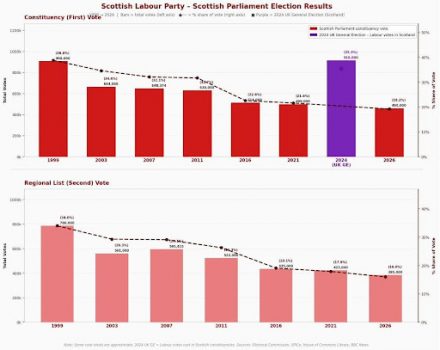
Less than two years ago, 916,000 people in Scotland voted Labour. In May 2026, roughly 460,000 did. About 400,000 voters who backed Labour at the general election did not come back at Holyrood. The instinct is to blame the campaign, the leader, and individual policies. But Scottish Labour’s Holyrood vote has fallen at every election since devolution began — six consecutive declines. No change of leader, message, or political weather has reversed it. The causes are not circumstantial. They are structural and psychological.
The moral foundations of voting
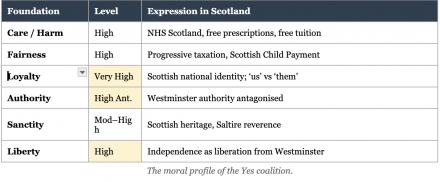
The social psychologist Jonathan Haidt argues that people do not arrive at political positions through rational policy assessment. They arrive through moral instinct — gut responses about fairness, loyalty, freedom, authority — and construct justifications afterwards. Several of these “moral foundations” matter for Scottish politics.
Care — the instinct to protect the vulnerable, driving support for the NHS and the welfare state.
Fairness — the engine of redistribution and progressive taxation.
Loyalty — in-group bonds, powerfully attached in Scotland to national identity.
Authority — critically, this can be antagonised as well as valorised; in Scotland, it has been activated against Westminster.
Liberty — the instinct for freedom from domination, experienced by many Scottish voters as the case for independence.
READ MORE: RECAP: Scottish Parliament elections – results and reactions
These foundations reinforce each other. A voter who feels strong Scottish loyalty, strong anti-Westminster sentiment, and a strong instinct for liberty is experiencing a mutually reinforcing psychology that makes the SNP’s offer feel right at a level that precedes policy. The SNP does not need to be competent. It needs to feel like it is on Scotland’s side.
The flip, the flop, and the flip back
Before 2014, Scottish politics was stable: Labour at 40 per cent on care and fairness, the SNP at 15–20 per cent on identity nationalism. The independence referendum shattered that. It activated loyalty, authority-antagonism, and liberty in a large section of Labour’s electorate. A third to two-fifths of Labour voters voted Yes — not because they had assessed the fiscal case, but because the referendum forced a moral question: whose side are you on? Labour’s numbers inverted. They flipped.
In 2024, the target of anti-authoritarian energy temporarily shifted. After fourteen years of Tory government, Labour was the instrument for removing the Conservatives. This was not a conversion. It was tactical relenting — convenience, not identity. The moral foundations had not changed. The target had. They flopped, briefly, to Labour.
By 2026, Labour was the UK government. It was the authority. For voters whose defining instinct is moralised anti-authoritarianism, that made Labour the enemy again — regardless of its record. Rail nationalisation, the Employment Rights Act, Great British Energy in Aberdeen, the removal of the two-child cap, £2.9 billion in additional Barnett consequentials — none of it engages the moral foundations that drive these voters. They flipped back.
Where Labour wins, and where it loses
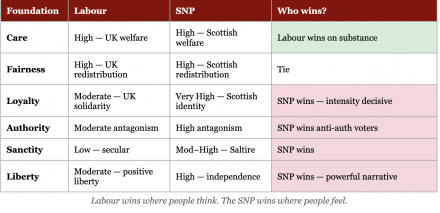
What is happening in Scotland is not unique. Across the democratic world, broad-church social democracy is fracturing into a pragmatic wing that accepts institutional authority and a moralised anti-authoritarianism that regards any governing party as compromised. In England the beneficiary has been the Greens. In Scotland it is the SNP, because Scottish nationalism provides a permanent vessel for anti-Westminster moral energy.
Become a friend of LabourList and join our community. Our friends support our vital non-factional work and get access to exclusive content and events.
The structural bind
Here is the conclusion most Labour strategists will resist: Scottish Labour’s Holyrood fortunes may be structurally counter-cyclical to Westminster success. When Labour governs, it becomes the authority that anti-authoritarian voters define themselves against. When it does not, the Tories occupy that role, and Labour can benefit.
The party’s task is not to chase voters it cannot reach. It is to consolidate the voters it can hold, build a distinctively Scottish Labour identity, and develop the moral language to recapture anti-authoritarian voters when conditions change. Most of the 400,000 who flipped away are unlikely to return while Labour governs in Westminster— though some may still vote Labour at a general election to defeat the Conservatives or block Reform.
The votes existed in 2024. They will exist again when the political conditions shift. The question is whether Scottish Labour uses the intervening years to understand why people vote the way they feel, not the way they calculate — or whether it spends those years repeating the same baffled complaint: ‘but look at our new policies’.
Subscribe here to our daily newsletter roundup of Labour news, analysis and comment– and follow us on TikTok, Bluesky, WhatsApp, X and Facebook. You can also write to our editor to share your thoughts on our stories and share your own. The best letters are published every Sunday.
-
- SHARE: If you have anything to share that we should be looking into or publishing about this story – or any other topic involving Labour– contact us (strictly anonymously if you wish) at [email protected].
- SUBSCRIBE: Sign up to LabourList’s morning email here for the best briefing on everything Labour, every weekday morning.
- BECOME A FRIEND: If you enjoyed this, why not consider becoming a Friend of LabourList? Help sustain our journalism, and of course Friends do get benefits…
- PARTNER: If you or your organisation might be interested in partnering with us on sponsored events or projects, email [email protected].
- ADVERTISE: If your organisation would like to advertise or run sponsored pieces on LabourList‘s daily newsletter or website, contact our exclusive ad partners Total Politics at [email protected].



More from LabourList
‘Jack Charlton and Labour’s rural tradition’
Labour triumphs against Polanski, but the Green threat remains
Delivering in Government: your weekly round up of good news Labour stories