

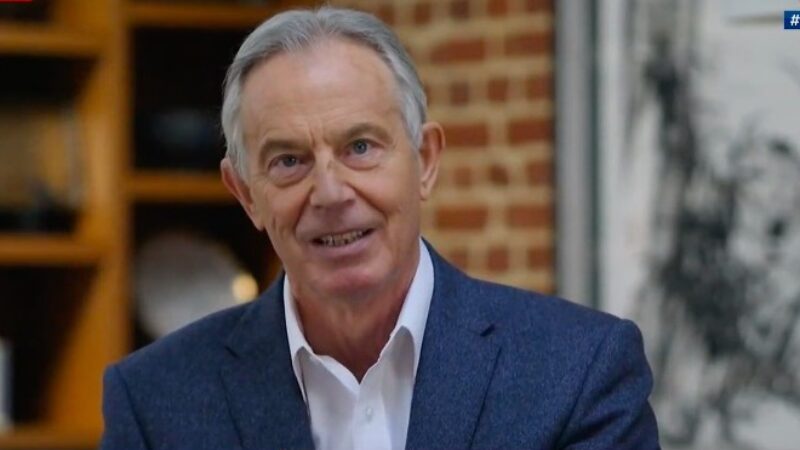

Keir Starmer and his leadership rivals must ditch Labour’s “self-delusion” to succeed, Tony Blair has said, in a highly critical essay in which he criticises ministers’ net zero policies and calls for the party to embrace AI.
The former prime minister made the step of directly and in detail critiquing the record of the Labour government since it took office, urging Andy Burnham, Wes Streeting and other MPs not to shift to the left in a future leadership contest.
Writing for his eponymous institute, Blair said: “The Labour Party is playing with fire; or, more accurately, with its future, and that of the country.
“Like many progressive parties, it has an almost infinite capacity for self-delusion.
Become a friend of LabourList and join our community. Our friends support our vital non-factional work and get access to exclusive content and events.
“It won the 2024 election not by acclaim, but by being an acceptable… default option to a Conservative government the country felt had behaved unacceptably.”
He continued: “The government’s principal problem isn’t Keir’s personality.
“It is because we don’t have a worked-out, coherent plan for the country in a fast-changing world and are in the wrong political position from which we can devise one and win a second term.
“The government is governing from an essentially traditional Labour ‘soft left’ position, parked firmly in the party’s comfort zone.”
The former prime minister, who led the party to three consecutive general election victories, is the most popular Labour leader of the last 40 years, according to exclusive polling for LabourList.
That popularity remains despite major controversies in office, such as the war in Iraq. Since leaving politics, Blair also been an adviser range of regimes in the Middle East and beyond, while also becoming an enthusiastic advocate of AI, largely through his Tony Blair Institute for Global Change.
He was also recently appointed to Donald Trump’s “Board of Peace” for Gaza.
While Blair praised Streeting as a “huge political talent” and Burnham as an outstanding Blair-era minister, he said the current leadership debate “has an extraordinarily retro 20th-century feel to it”.
Blair’s suggested that the Labour leadership should have dropped a swathe of manifesto policies once elected, taking aim in particular at the Employment Rights Act, Ed Miliband’s net zero policies and the decision to increase minimum wage.
He instead offers solutions that run counter to much of Labour’s policy agenda currently.
“Our aim,” he wrote, “should be a Reimagined State in which taxes and spending can be lower, productivity higher and government seen as enabling not directing, with political consensus behind such a radical restructuring of the state”.
Tax Rises
Blair joined a chorus of business lobby groups in criticising Chancellor Rachel Reeves’ tax increases in her first Budget.
“We chose a rise in National Insurance not VAT to plug the fiscal gap in the first Budget. Either tax increase would have been unpopular. Only one undermined business confidence,” he wrote.
Labour’s manifesto saw it commit not to “increase taxes on working people”, promising not to raise national insurance, income tax rates, or VAT.
While Reeves has stuck to the letter of this pledge, taxes are nonetheless rising, with the Treasury keeping income thresholds frozen until 2031.
There has been considerable pressure on the Chancellor, largely from the soft-left, for a shake-up of her fiscal rules in order to release more funds for long-term capital investments.
Subscribe here to our daily newsletter roundup of Labour news, analysis and comment– and follow us on TikTok, Bluesky, WhatsApp, X and Facebook. You can also write to our editor to share your thoughts on our stories and share your own. The best letters are published every Sunday.
Energy
Blair hit out specifically at “the net-zero acceleration and phasing out of the British oil and gas industry”.
“We must prioritise cheaper energy and electrification over net zero and use what is left of our North Sea oil and gas resources. This is essential for our competitiveness and for taking advantage of AI,” he wrote.
His comments run counter to Ed Miliband’s own policies. The energy secretary, who some in Westminster believe could become Chancellor if Burnham becomes prime minister, has repeatedly stressed the need to go faster on green policies.
The 2024 manifesto committed Labour to not approving new licenses for North Sea drilling, but not to tear up existing licenses.
Since the start of the war in Iran, Miliband has also insisted that expanding drilling in the North Sea would not reduce domestic energy prices for UK homes or businesses.
The party has also sought to drastically speed up planning applications for major green energy projects and grid infrastructure.
Blair said that the “government has taken significant steps” on planning “but well short of a truly radical reform”.
Workers’ rights
Blair took aim at one of Labour’s flagship policies, namely the Employment Rights Act.
The decision to raise the minimum wage, alongside the improvement in workers’ rights, were described as among the measures that have “given headwinds not tailwinds to British business”.
After a back-and-forth with the House of Lords, and amid pressure from trade unions, the Employment Rights Act became law in December.
Among an array of reforms, it banned fire-and-rehire, granted parental leave from day one, and improved trade union rights in the workplace.
But facing pressure from business, ministers did concede ground, removing the original promise to strengthen protection for unfair dismissal claims from their first day in the job.
EU and US
The Labour leadership’s tone on Donald Trump has hardened in recent months, in the wake of the war in Iran. Starmer has made much of the decision not to join the war effort, while Reeves has bluntly called the conflict a “mistake”.
While Starmer has said the UK remains fully committed to Nato, a 10-year defence investment plan has been repeatedly delayed. Labour has an “ambition” to spend three per cent of GDP on defence by the next parliament.
Blair, in the essay, said that “America First” security concerns – on Iran, China, Russia – are no different from Europe’s.
“President Trump has demanded increases in NATO spending not dissolution of the alliance,” he wrote.
Calling the current UK-US partnership “weaker”, Blair said he understood why the UK had refused to grant America the use of British military bases for the war, but it was “not the best way to treat our ally”.
On Europe, Blair also offered his own version of how UK-EU integration should look. “If we want to go back into some sort of structured relationship with Europe, we can only do so from a position of economic strength.
“We must be at the farthest end of European competitiveness. At present, we’re not.”
Blair called for a focus on technology, defence and energy in any renewed relationship.
The UK and the EU are currently in the middle of negotiations, with hopes of securing an veterinary agreement in the coming weeks, as well as a youth mobility scheme.
Under Labour, British students will soon be able to take part in Erasmus study opportunities once again.
There are also talks underway on Britain returning to the EU internal market for electricity. But red lines remain on re-entry to the customs union and single market, even if Wes Streeting has already signalled plans for a more ambitious EU relations policy if he were to become leader.
Welfare
Blair used his essay to call the state pension triple lock “unaffordable long term” and urged ministers to engage in a “plan for fundamental reform” of welfare.
“If the Conservative Party repeats its offer of working together on welfare, Labour should accept the offer,” Blair said.
Liz Kendall, and her successor as work and pensions secretary Pat McFadden, have already embarked on a range of welfare reforms.
Alan Milburn, a health secretary under Blair, is due to report back this week on how to solve Britain’s worsening problem of youth inactivity.
But some reforms have run into trouble. Last summer, a threatened rebellion by over 100 MPs secured major concessions from the government on the welfare bill, with anger in particular from backbenchers over cuts to personal independence payments.
Reeves has said that the triple lock, which protects state pensioners from inflationary spikes, is not up for negotiation, despite the growing cost.
-
- SHARE: If you have anything to share that we should be looking into or publishing about this story – or any other topic involving Labour– contact us (strictly anonymously if you wish) at [email protected].
- SUBSCRIBE: Sign up to LabourList’s morning email here for the best briefing on everything Labour, every weekday morning.
- BECOME A FRIEND: If you enjoyed this, why not consider becoming a Friend of LabourList? Help sustain our journalism, and of course Friends do get benefits…
- PARTNER: If you or your organisation might be interested in partnering with us on sponsored events or projects, email [email protected].
- ADVERTISE: If your organisation would like to advertise or run sponsored pieces on LabourList‘s daily newsletter or website, contact our exclusive ad partners Total Politics at [email protected].



More from LabourList
‘Playing it safe on Europe is the riskiest thing Labour can do’
‘Jack Charlton and Labour’s rural tradition’
Labour triumphs against Polanski, but the Green threat remains