

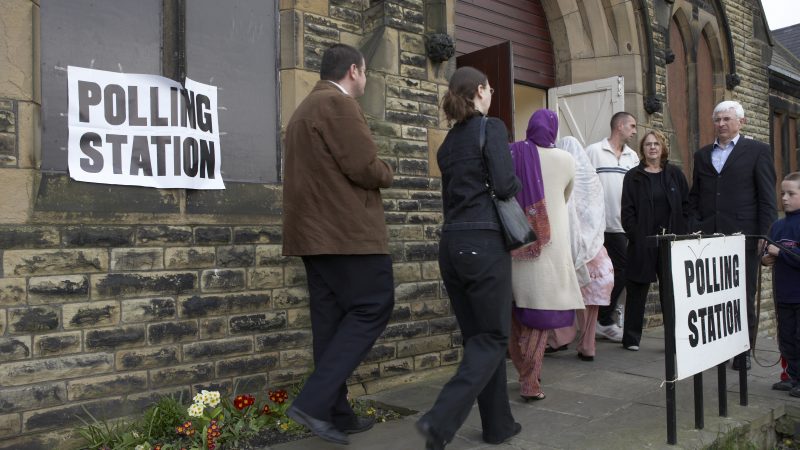

The most urgent task for whoever leads the Labour party is to address the challenge of Labour’s splintering vote. Last week’s local elections showed Labour losing support across the nations of Britain and across almost every type of English constituency — from post-industrial towns to diverse inner cities. It lost votes both to parties on its left and to parties on its right. The projected national vote share for Labour and the Conservatives combined was just 34 per cent — the same vote share Labour alone achieved at the General Election.
For much of the post-war period, both Labour and the Conservatives could rely on the electoral ballast of voters with strong partisan loyalties rooted largely in social class. Today, however, voters are increasingly expressive rather than tribal, many support the party that best reflects their values rather than feeling bound by a class, ethnic or geographic identity. The difficulty for Labour is that modern Britain contains many different and often conflicting value systems.
In the light of this it is reasonable to ask whether it is still possible for a mainstream political party to hold a genuinely broad electoral coalition together?
READ MORE: ‘Learning Lessons’
Labour strategists have no shortage of advice about which voters Labour should prioritise. Danny Finkelstein argues it should focus on middle-class liberals. Maurice Glasman says it should rebuild among working-class voters. Neal Lawson argues Labour should focus on winning back progressive voters lost to the Greens and Liberal Democrats. The external impression of Morgan McSweeney’s strategy, meanwhile, was that Labour should prioritise voters drifting to the right.
Labour still needs a broad coalition
The problem is that none of these groups alone is large enough. Under First Past the Post, parties that can get above roughly 30 per cent of the vote are disproportionately rewarded, while those below it face volatile and often punishing outcomes. Labour therefore still requires some form of broad coalition.
At the last election, Labour won that coalition partly by inviting voters with very different values and attitudes into a big tent without being clear about what was inside it. Voters with very different priorities were able to project their own assumptions onto Keir Starmer’s Labour. But once in government, many discovered that the party inside the tent did not match the one they had imagined. It was a strategy which delivered a landslide victory, but proved unable to deliver stability in power.
A new ThinkLabour report, “Who is Labour For?”, argues that a broad coalition is still possible — but only if Labour becomes clearer about both its values and its purpose.
The report begins by asking why people support political parties at all. Polling conducted in the areas that voted in last week’s local elections found that almost a third of voters (32 per cent) backed the party they supported because it “shared their values”. A further 21 per cent said they supported a party because it “stood up for people like me”.
But many voters are more transactional. A quarter (24 per cent) said they supported a party because it had the best policies on the issue they cared most about. Another 24 per cent admitted: “It isn’t great but it’s better than the alternatives.”
Outward looking, economically left leaning and moderately socially liberal
A broad coalition will contain all these types of voters, but it needs skilful management to hold people with very different priorities and attitudes together. The local election results suggest Labour is not succeeding in this. It seems to many that the government has treated its values-based progressive voters transactionally — raising the minimum wage, taxing business, lifting the two-child cap and nationalising rail without consistently articulating the broader progressive rationale behind those decisions. Meanwhile critics have argued that it has attempted to connect with voters it has lost to its right with language and values which have at times felt inauthentic to Labour. This has alienated some progressives and ultimately, has failed in its objective of winning back voters lost to right-wing parties.
Become a friend of LabourList and join our community. Our friends support our vital non-factional work and get access to exclusive content and events.
ThinkLabour argues for the opposite approach. To retain progressive and left-liberal voters, the Party must clearly present itself as an outward-looking, economically left-leaning and moderately socially liberal party. It needs to reconnect its policies to Labour’s historic mission: standing up for people facing economic insecurity and creating a fairer society. Those who are economically insecure have been much more likely to switch away from Labour than those who are financially comfortable.
At the same time, Labour also needs to accept that not all of its potential voters will share all of those values. Many voters are pragmatic and will support whichever party they believe can govern competently and improve their lives. To win these more transactional voters, Labour needs to demonstrate competence and delivery — particularly by relentlessly driving economic growth, improving the NHS and controlling irregular migration.
Hard choices and difficult trade-offs
Given the dire inheritance Labour received from the Conservatives, the international crises that have followed, and nearly two decades in which many voters feel their lives have not materially improved, this will be difficult. It will require hard choices and difficult trade-offs. It will sometimes mean doing things that opinion polls suggest are unpopular in the short term. And it will demand the honesty and political courage to explain those choices to the public against a backdrop of populist parties on both the left and the right offering seemingly simple, cost-free solutions.
Labour therefore needs to make better use of incumbency. It has become fashionable to claim incumbency is now purely a disadvantage, especially in an era of repeated economic and geopolitical shocks for which governments are blamed regardless of responsibility. But incumbents still retain major advantages: they have the power to act and to explain their decisions using the platform of government.
And Labour’s opponents are flawed. Reform UK is already polling below the peaks it reached last summer, which was reflected in the local election projected national share, where it was down four points on the previous year. Nigel Farage’s personal ratings have also fallen back. Meanwhile, Zack Polanski’s evident lack of judgement appears to have damaged the Greens in the run-up to the elections.
Subscribe here to our daily newsletter roundup of Labour news, analysis and comment– and follow us on TikTok, Bluesky, WhatsApp, X and Facebook. You can also write to our editor to share your thoughts on our stories and share your own. The best letters are published every Sunday.
To defeat these parties, Labour must use its time in government to deliver outcomes strong enough to persuade transactional voters that re-electing it offers the best prospect of improving their lives at the next General Election. At the same time, it should use the platform of government to articulate a clear and consistent narrative about why its choices are necessary and how they reflect its core principles to those left-liberal voters who share its values.
-
- SHARE: If you have anything to share that we should be looking into or publishing about this story – or any other topic involving Labour– contact us (strictly anonymously if you wish) at [email protected].
- SUBSCRIBE: Sign up to LabourList’s morning email here for the best briefing on everything Labour, every weekday morning.
- BECOME A FRIEND: If you enjoyed this, why not consider becoming a Friend of LabourList? Help sustain our journalism, and of course Friends do get benefits…
- PARTNER: If you or your organisation might be interested in partnering with us on sponsored events or projects, email [email protected].
- ADVERTISE: If your organisation would like to advertise or run sponsored pieces on LabourList‘s daily newsletter or website, contact our exclusive ad partners Total Politics at [email protected].



More from LabourList
‘Playing it safe on Europe is the riskiest thing Labour can do’
‘Jack Charlton and Labour’s rural tradition’
Labour triumphs against Polanski, but the Green threat remains