

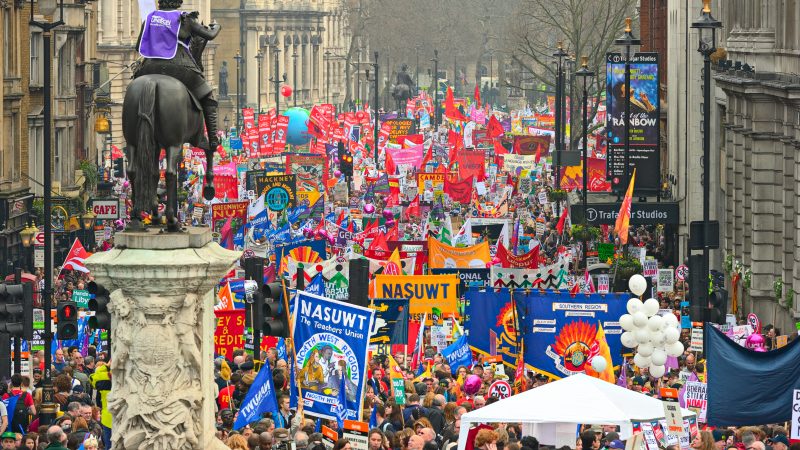

Just as many trade union members support Reform as support Labour, according to a recent poll. Many local trade union officials admit privately that Reform is hoovering up many of their members.
Some Reform councillors have unexpected allies. A local union official told me: “Our new Reform Party chair is a former shop steward and wants to have regular meetings with us. So we’re not going to rock the boat by criticising them.”
The Greens, too, got plenty of trade union credit for supporting the Birmingham refuse workers against the Labour council. Zack Polanski, on the picket line with Birmingham refuse workers, said: “Labour has to stop saying that workers don’t deserve anything better.”
A recent Barnet Green Party circular to members says: “Barnet’s cleaners are not being paid on time. Many are low-paid workers. This is not fair. UNISON has launched a petition. If we reach enough signatures, the Council must listen.”
READ MORE: GMB Congress reaffirms Labour affiliation
Polanski was cheered to the rafters at the National Education Union’s annual conference for a speech which, just a few years ago, could have been given by a Labour Party leader.
Polanski is talking to several unions, and is due to address the annual conference of the University and College Union, having just addressed the Bakers Union, whose president Ian Hodson says the Greens are “engaging with trade unions at a time when many working-class people feel increasingly unrepresented.”
None of this is surprising, given the attitude of Labour’s top brass, neatly summed up in one of those newly released Mandelson files. Darren Jones, Chief Secretary to the Prime Minister, wrote to Peter Mandelson: “I lost faith (in Jonathan Reynolds’s advisers) when, on a call about Port Talbot, they repeatedly took a different position from us because ‘that’s what the unions want.’” This is a Labour minister talking about the employment of hundreds of union members.
Does it matter? How on earth did we get here? And what can we do about it?
It matters terribly. We are watching the dismantling of a partnership created 126 years ago to redress the balance between capital and labour, and give workers the power and confidence to demand decent treatment.
The power, influence and membership of the unions have declined catastrophically since 1979, when TUC-affiliated trade unions had almost 13 million members, more than half the workforce. It’s now just over 5 million.
Of course the malevolence of Margaret Thatcher, the stupidity of Arthur Scargill, and the gig economy all played their part in this decline. But something changed in the unions too. Their power had been built on their strength in the workplace, but a new generation of union leaders and activists started to see unions as agents of political change, and their power as an end in itself.
Union mergers in the 1980s saw many small craft unions disappear, their members being transferred to a big general union. This gave more members to the big union (generally, but not always, the Transport and General Workers Union, now Unite). But many of the small craft unions’ members did not transfer their loyalty to the bigger organisation.
Become a friend of LabourList and join our community. Our friends support our vital non-factional work and get access to exclusive content and events.
The big union benefitted, but the trade union movement as a whole was poorer. The big union increased its block vote in the Labour Party, and a new generation of union leaders enjoyed being seen as political power-brokers. A new generation of activists started believing they could use the unions as the means to change the world. Every matter of public policy, from the Middle East to abortion on demand, became the subject of heated debate at trade union conferences, which often found themselves only reluctantly dragged back to mundane matters like wages and conditions at work.
All this was manna to the unions’ many enemies in the media, and Labour politicians began asking themselves whether they were better off without having the unpopularity of the unions hung round their necks.
1994 saw the election of the first Labour leader ever who had neither a background in the unions nor a high regard for them. Tony Blair was assured by Peter Mandelson that his only hope of election lay in doing things which would cause the unions to attack him.
New Labour credited Mandelson for winning the 1997 general election by distancing Labour from its past, and in particular from its alliance with the unions. The then TUC general secretary John Monks quickly noticed that the Labour government seemed to regard unions as “embarrassing elderly relatives at a family gathering.”
Too late, another new generation of union leader has seen the harm that was being done. Gary Smith was elected general secretary of the GMB in 2021 on a manifesto that said: “GMB isn’t a political party, think tank, campaign group, or charity. We must be about asserting power in the workplace.”
Fascist populists win when the left is seen to fail to deliver. And the problem for Labour is neatly summed up by Liam Byrne in his brilliant new book Why Populists Are Winning and How to Beat Them: “When politicians appease markets, voters revolt; when they appease voters, markets revolt.” Labour governments are more frightened of the markets than they are of the voters.
Take away the unions – take away Labour’s historic role as the political voice of organised labour, as the party that exists to tilt the balance away from the bosses and towards the workers – and what are you left with? Surely not a socialist party.
Keir Starmer’s fatal mistake was believing that the 30-year-old prescription of Peter Mandelson would still work: make sure no one thinks you listen to the unions, and be seen to bash the left. While Starmer listened to Mandelson, Labour’s opinion poll rating collapsed to the lowest level in its history.
Labour needs the unions, not for their money (they have much less of that than they used to) but because they give the Party a sense of purpose. Take the unions away and you have an empty shell. The unions need Labour for exactly the same reason that they formed the LRC in 1900: to represent the workers in parliament.
Liam Byrne’s strategy for beating the populists is inspired by Franklin D. Roosevelt’s New Deal. “Populists prey on despair” he writes. “They tell people the game is rigged and only a strong man can fix it. They build movements bound more by grievance than by hope, financed by dark money and fuelled by digital rage.”
Polling data shows that most of those who back Reform would also back targeted levies on the rich and powerful; windfall taxes on energy companies and banks; and crackdowns on offshore tax havens. Reform cannot and will not give them any of these things. The left can, if it has the will.
The will can come from knowing who it is you represent. Labour represents the sort of people for whom trade unions were created; or it represents no one.
Subscribe here to our daily newsletter roundup of Labour news, analysis and comment– and follow us on TikTok, Bluesky, WhatsApp, X and Facebook. You can also write to our editor to share your thoughts on our stories and share your own. The best letters are published every Sunday.
-
- SHARE: If you have anything to share that we should be looking into or publishing about this story – or any other topic involving Labour– contact us (strictly anonymously if you wish) at [email protected].
- SUBSCRIBE: Sign up to LabourList’s morning email here for the best briefing on everything Labour, every weekday morning.
- BECOME A FRIEND: If you enjoyed this, why not consider becoming a Friend of LabourList? Help sustain our journalism, and of course Friends do get benefits…
- PARTNER: If you or your organisation might be interested in partnering with us on sponsored events or projects, email [email protected].
- ADVERTISE: If your organisation would like to advertise or run sponsored pieces on LabourList‘s daily newsletter or website, contact our exclusive ad partners Total Politics at [email protected].



More from LabourList
‘Back Burnham over Brexit’
Delivering in local government: How Labour is building a better Britain everywhere
‘Changing our voting system is fundamental to Burnham’s agenda’