



Less than two years after its landslide general election victory, Labour has faced a tough set of local elections where Labour lost 1,496 council seats. The speed and scale of local election losses are stark, posing the question ‘what has caused Labour to face such electorally challenging times?’
READ MORE: ‘An exceptionally bad year across all measures’
The 2025 British Election Study (BES) provides many useful insights in answering this question. It shows that Labour’s 2024 coalition has fragmented across multiple parties. This has been driven by differing values and priorities, frustration over the Labour government’s perceived lack of delivery and a weakened party brand.
Where Labour’s 2024 voters have gone
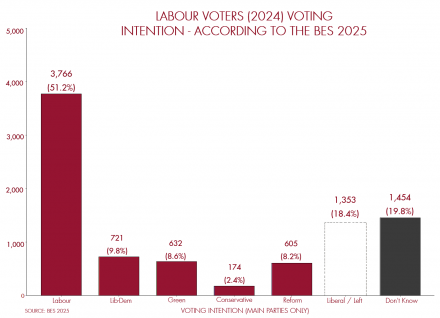
Only just over half of Labour’s 2024 voters still plan to support Labour in a future election, highlighting why Labour councillors faced an uphill challenge in retaining their seats. The largest single group of losses are voters who now say they “don’t know” how they would vote. With many voters being undecided going into these local elections and Labour’s losses being substantial, it is likely these voters backed another party to voice their disappointment with Labour.
Among voters who have switched to another party:
- 18.4 per cent of Labour’s 2024 voters now back the Greens or Liberal Democrats
- 8.2 per cent have switched to Reform UK
- 2.4 per cent have returned to the Conservatives
Post-Polanski becoming leader, the Greens are enjoying higher polling ratings. Further, their membership surge allowed the party to contest far more council wards. Likewise, Reform has enjoyed higher ratings since Farage entered parliament. Additionally, Reform has built local organisations in areas where these barely existed when many of these councils were last fought. Therefore, as both the Greens and Reform are significantly stronger and contested more council wards, they made significant gains. The Greens secured 441 more seats and Reform 1,451, many from directly from Labour.
Different voters, different threats
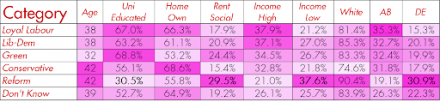
Labour’s losses are not evenly distributed. Lib-Dem losses skew slightly more towards homeowners and higher incomes, but the overall picture is similar. Voters drifting to the Greens and Lib Dems are disproportionately:
- Younger
- University-educated
- Professionally employed
- More ethnically diverse
- More socially and culturally liberal, such as being pro-EU and pro-immigration.
These voters cluster in urban areas. Importantly, many seats in these areas were contested this year, meaning Labour lost a large number of seats to the Lib-Dems and Greens.
Labour’s Reform losses come from contrasting demographics. They are:
- Older
- Less likely to own their home
- Less likely to have attended university
- More often are on a Lower income
- More frequently work in working-class (DE) occupations
- More concentrated in ethnically homogeneous communities
- More socially and culturally authoritarian, such as being anti-EU and anti-immigration.
These patterns point to former industrial towns that once comprised Labour’s strong Red Wall. Once again, Labour found itself trying to hold together a broad coalition, thus producing a difficult electoral landscape for the party to navigate. This led to Labour losing to Reform in contrasting areas to those it lost to the Greens.
Different values and priorities
Labour’s former voters prioritise different issues.
Among Labour voters who have switched to the Lib Dems or Greens:
- 66 per cent of Lib Dem switchers and 51 per cent of Green switchers say the economy and cost of living are their top issues.
- 29 per cent of Green switchers and 10 per cent of Lib Dem switchers prioritise the environment. A further 10 per cent prioritise the NHS.
- Fewer than 10 per cent cite immigration as a major concern.
For 2024 Labour voters voters who backed Reform last week, the picture is very different:
- 62 per cent say immigration is their top priority.
- Only 30% say that the economy is their most pressing concern.
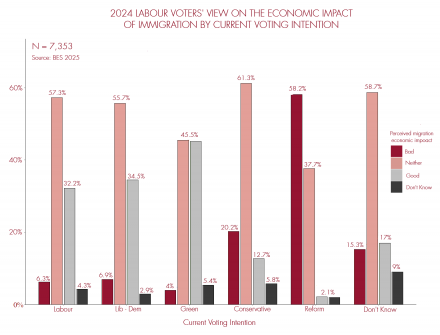
The values gap is evident when views on immigration are explored. Eighty-eight per cent of Labour voters who switched to Reform want migration levels reduced. By contrast, roughly half of Green and Lib Dem defectors support keeping immigration at current levels, while 21 per cent of Lib Dem losses and 31 per cent of Green losses would accept an increase.
On the economic impact of immigration, 58 per cent of Labour-to-Reform switchers believe it harms the economy. Among Green and Lib Dem losses, fewer than five per cent have this opinion . Therefore, Labour struggled to keep its 2024 base in these local elections partly because these voters often prioritise different concerns, which, as we shall next see, they both feel Labour are not addressing.
Disappointment with Labour in government
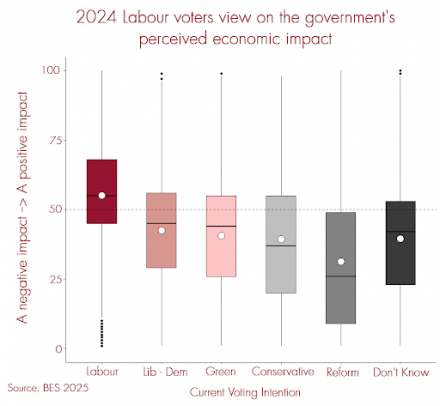
Another factor that made these local elections tough for Labour is disappointment with Labour’s performance in office.
Roughly two-thirds of Labour voters who have since switched to the Greens, Lib Dems or have become undecided believe the Labour government has worsened the economy. Among Reform switchers, that figure rises to 75 per cent.
Become a friend of LabourList and join our community. Our friends support our vital non-factional work and get access to exclusive content and events.
Despite wages beginning to outpace inflation, perceptions remain pessimistic. Forty-seven per cent of Labour’s Green and Lib Dem losses say their household finances or local economy have deteriorated, a view shared by 60 per cent of Reform switchers.
Salient policy decisions have sharpened this sense of disappointment. Winter fuel payment cuts, proposed changes to disability benefits and tax decisions likely have contributed to a perception that the government is failing to deliver the economic change it promised.
Dissatisfaction goes far beyond the economy:
- 44 per cent of Lib Dem, 54 per cent of Green, and 71 per cent of Reform losses believe Labour is mishandling the NHS
- 51 per cent of Reform switchers think Labour is running education badly (compared with 33 per cent of Lib Dem and 37 per cent of Green losses)
- On immigration, 92 per cent of Reform switchers believe Labour is performing badly.
Belief in party competence has shifted decisively. Seventy-five per cent of Labour voters who now back Reform say Reform is best on their top issue. Among Green losses, 54 per cent now say the Green Party is best on the issues they most value.
This means that going into the local elections, Labour was perceived as not able to deliver on its supporters’ core concerns. This provided tough conditions for Labour candidates to operate in, likely leading to many losing seats that would have otherwise been won.
A weakened party brand
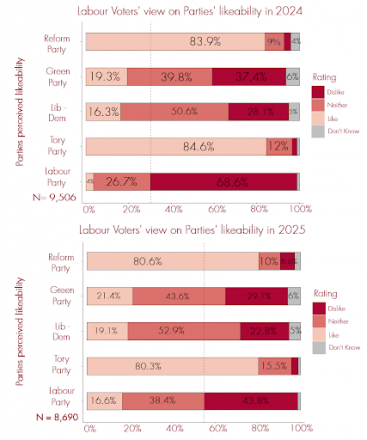
Another contributor to Labour’s local election losses stemmed from the Labour Party’s image itself. In 2024, Labour enjoyed the strongest brand of any party: 69 per cent of its voters held a positive view of the party. By 2025, that figure had fallen to 44 per cent, a 25-point collapse. In contrast, those who disliked Labour rose by 12 points.
Crucially, many feel Labour isn’t behaving like a Labour government. Twenty-five per cent of Labour-to-Green switchers and 15 per cent of Labour-to-Lib Dem switchers describe the party as right-wing, compared with just five per cent of those who remain loyal. Consequently, all this highlights the potential that unpopular policy decisions voters would not associate with a Labour government, such as winter fuel cuts, have weakened Labour’s appeal.
Reform defectors most often share a negative view: 60 per cent now hold an unfavourable view of Labour, versus 32 per cent of Green losses and 25 per cent of Lib Dem losses. Therefore, it is likely that Labour candidates found it very hard to win in these local elections, partly because the party they stood for had a less popular image than in previous years.
Why these local elections were so challenging for Labour
The 2026 local elections demonstrated that Labour’s 2024 support base has fractured along sociological and ideological lines. Smaller parties now have sufficient public support and organisational strength to exploit Labour’s weakened position. Further, a governing party that promised change is widely seen as having failed to deliver it, leading to voters deciding to punish Labour in the local elections. Finally, unpopular actions and negative headlines have weakened the Labour Party brand, something which led to many Labour councillors losing their seats.
Therefore, these local elections present Labour with a tough reality: the coalition which carried it into power may already be gone. This has not only presented Labour with a tough set of local elections, but a tough road ahead for the rest of the parliament. To perform better in future, Labour needs to realise its 2024 base is not sustainable, and instead focus on uniting its more numerate progressive potential support base. It also must communicate its successes in government to improve how voters perceive it.
The original research for this article was released in Uneven Ground, a pre-election pamphlet from the Fabian Society by the author. The views and analysis are those of the author and not any other organisation.
Subscribe here to our daily newsletter roundup of Labour news, analysis and comment– and follow us on TikTok, Bluesky, WhatsApp, X and Facebook. You can also write to our editor to share your thoughts on our stories and share your own. The best letters are published every Sunday.
-
- SHARE: If you have anything to share that we should be looking into or publishing about this story – or any other topic involving Labour– contact us (strictly anonymously if you wish) at [email protected].
- SUBSCRIBE: Sign up to LabourList’s morning email here for the best briefing on everything Labour, every weekday morning.
- BECOME A FRIEND: If you enjoyed this, why not consider becoming a Friend of LabourList? Help sustain our journalism, and of course Friends do get benefits…
- PARTNER: If you or your organisation might be interested in partnering with us on sponsored events or projects, email [email protected].
- ADVERTISE: If your organisation would like to advertise or run sponsored pieces on LabourList‘s daily newsletter or website, contact our exclusive ad partners Total Politics at [email protected].



More from LabourList
Labour triumphs against Polanski, but the Green threat remains
Delivering in Government: your weekly round up of good news Labour stories
Labour members willing to accept Green defections, but not Tories or Reform – poll