

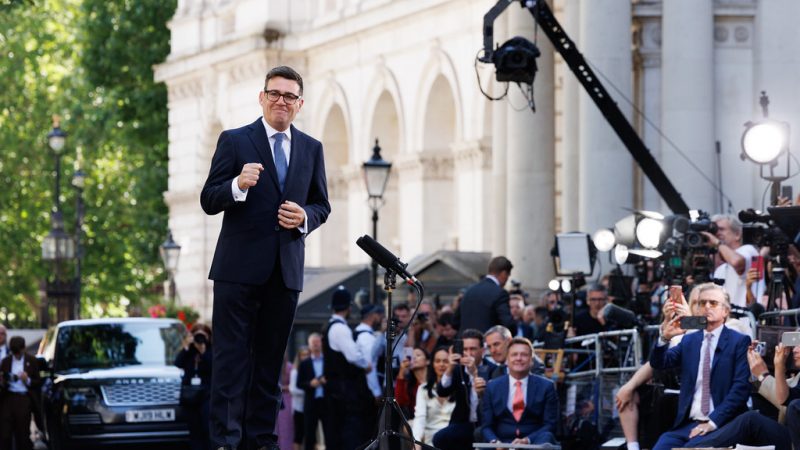

As Andy Burnham begins his first full day as Prime Minister, three things are clear: he will govern quite differently from Keir Starmer, he’s ready to hit the ground running, and – perhaps most crucially – he’s prepared to be bold in his vision for Britain.
Within 24 hours, Burnham has shaken up Whitehall and assembled a new government with a much more northern voice. As he removed almost a dozen Starmer loyalists, more than half of Burnham’s Cabinet are from the north of England – with five from Greater Manchester. John Healey, in a move that surprised many a political pundit, will be joining him at Number 11 – a move he described to NATO’s secretary general as a “signal of his intent”. While he split the Department of Science and Technology, he’s rewarded Kanishka Narayan’s work on AI with a seat at the Cabinet table.
From his first speech, Burnham set out an ambitious vision for the country: a new political model, a new economic model, and a politics that is “more about problem-solving than point scoring”. His commitment to end rough sleeping reflects both his emphasis on delivery and one of the defining causes of his political career. Tackling homelessness was a central priority during his time as Mayor of Greater Manchester, and his determination to reduce inequality is set to be a defining feature of his premiership.
Become a friend of LabourList and join our community. Our friends support our vital non-factional work and get access to exclusive content and events.
Burnham has sought to make an immediate appeal to households struggling with the cost of living, with the promise of “breathing space” in the immediate term. Some of those measures are starting to take shape, with the removal of VAT from domestic energy bills from October. Funding such a move by junking the unpopular digital ID scheme could resonate with voters who had wavered in their support for Labour under the last administration.
The challenges ahead are obvious. Removing so many of Starmer’s allies risks creating a sizeable bloc of unhappy Labour MPs on the backbenches. Burnham will also have to navigate the same electoral coalition that frustrated his predecessor: appealing to voters swayed by the Greens without alienating those concerned about immigration, and all while keeping Britain’s borrowing costs as low as possible.
However, what is clear is that Burnham is attempting to revive a distinctly Labour tradition of economic populism – one rooted in tackling concentrated economic power, rather than exploiting cultural division. Whether Burnham’s experiment will succeed remains to be seen, but his premiership has begun with something different: a clear argument about the country he wants to build.
Subscribe here to our daily newsletter roundup of Labour news, analysis and comment– and follow us on TikTok, Bluesky, WhatsApp, X and Facebook. You can also write to our editor to share your thoughts on our stories and share your own. The best letters are published every Sunday.
-
- SHARE: If you have anything to share that we should be looking into or publishing about this story – or any other topic involving Labour– contact us (strictly anonymously if you wish) at [email protected].
- SUBSCRIBE: Sign up to LabourList’s morning email here for the best briefing on everything Labour, every weekday morning.
- BECOME A FRIEND: If you enjoyed this, why not consider becoming a Friend of LabourList? Help sustain our journalism, and of course Friends do get benefits…
- PARTNER: If you or your organisation might be interested in partnering with us on sponsored events or projects, email [email protected].
- ADVERTISE: If your organisation would like to advertise or run sponsored pieces on LabourList‘s daily newsletter or website, contact our exclusive ad partners Total Politics at [email protected].



More from LabourList
Delivering in local government: How Labour is building a better Britain everywhere
‘Changing our voting system is fundamental to Burnham’s agenda’
‘Labour has a chance to make the socio-economic duty mean something’