

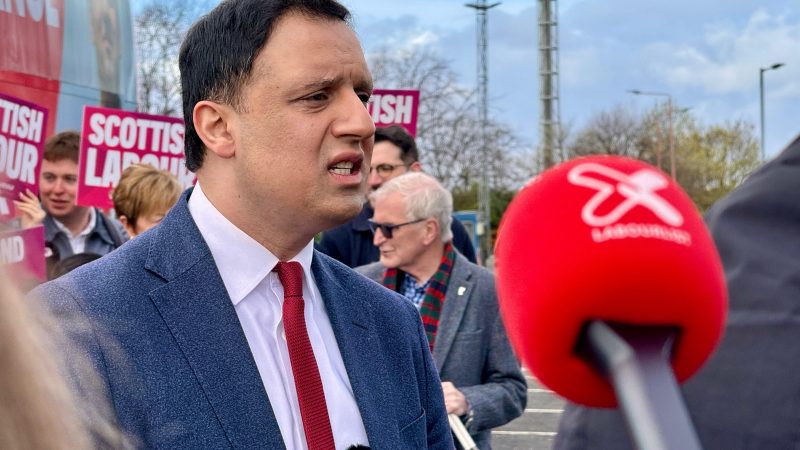

Scottish Labour leader Anas Sarwar is set to quit Holyrood to become a minister in Andy Burnham’s government.
Media reports suggest Sarwar, who was the first senior Labour figure to call for Keir Starmer’s resignation, will be elevated to the House of Lords and take up a ministerial role in Burnham’s revamped Department of Business, Innovation, Science and Trade.
Sarwar’s departure from the Scottish Parliament will lead to some immediate changes within the Scottish Labour group and also trigger a leadership election.
LabourList takes a closer look at what happens next, what the rules of a contest might be, and who could throw their hat into the ring to lead the party.
Does Sarwar’s resignation trigger a by-election for the Scottish Parliament?
While the resignation or death of a constituency MSP does trigger a by-election, the same is not true for those elected as regional MSPs. As Sarwar is a regional MSP for Glasgow, his seat is instead transferred to the next eligible and willing member on Scottish Labour’s party list from the May election. This would see Sarwar’s former leadership rival Monica Lennon, who lost her seat in Holyrood two months ago, return to the Scottish Parliament.
What are the rules for a Scottish Labour leadership election?
Procedural rules for a leadership contest are set out by the Scottish Executive Committee, so the exact terms and conditions for a new election may differ slightly from previous years. However, we can look to previous contests for an indication of how an election is likely to play out.
Historically, leadership candidates have had to be either an MSP or an MP to be eligible to run as Scottish Labour leader – although all but one of the successful candidates to date have been serving members of the Scottish Parliament.
Previous contests have required candidates to seek nominations from 15 percent of Scottish Labour’s MSPs and MPs. If that threshold remains the same for the next contest, candidates would need the backing of at least nine MPs or MSPs.
A period for ‘supporting nominations’ also takes place, where CLPs and party affiliates, including Labour-linked trade unions, can opt to endorse a candidate.
The length of the voting period for members has varied in the past. The last contest in 2021 saw members have roughly two weeks to cast their vote in a truncated contest, caused in part by the impending Holyrood election. However, the 2017 election saw members given three weeks to vote.
Become a friend of LabourList and join our community. Our friends support our vital non-factional work and get access to exclusive content and events.
Who might run in a leadership contest?
While no one has yet indicated their plan to stand if a leadership contest is triggered, several names have been touted as potential candidates for Scottish Labour leader.
Regional MSP for North East Scotland Michael Marra has been cited as a “clear frontrunner” to succeed Sarwar among some within the Scottish Labour Party. Marra, a close ally of Anas Sarwar, has previously described himself as being on the party’s “soft left” and previously served as shadow education secretary and shadow finance secretary. Reports suggest that Marra already has the support of several MPs and MSPs should he decide to stand.
Ally of Andy Burnham Paul Sweeney is also said to be considering a bid for the leadership. Sweeney, regional MSP for Glasgow and former MP for Glasgow North East, previously served in the army reserve and serves as the party’s shadow minister for mental health. Sweeney has been an early backer of greater powers for Greater Glasgow and has been a proponent of protecting Scotland’s shipbuilding industry and preserving the nation’s heritage and historic architecture.
A potential candidate could be Sarwar’s former leadership rival Monica Lennon, who would return to Holyrood upon his resignation. Lennon fell just short in the 2021 leadership election with 42 percent of the vote and has previously held roles as the party’s shadow secretary for health, economy and net zero. While in the Scottish Parliament, she introduced legislation which offered free period products across the nation.
Another figure who may choose to enter the fray is deputy leader Jackie Baillie, one of only two MSPs to have served since the formation of the Scottish Parliament in 1999 (the other being First Minister John Swinney). She will also take over as acting leader for a third time during the leadership election.
Subscribe here to our daily newsletter roundup of Labour news, analysis and comment– and follow us on TikTok, Bluesky, WhatsApp, X and Facebook. You can also write to our editor to share your thoughts on our stories and share your own. The best letters are published every Sunday.
-
- SHARE: If you have anything to share that we should be looking into or publishing about this story – or any other topic involving Labour– contact us (strictly anonymously if you wish) at [email protected].
- SUBSCRIBE: Sign up to LabourList’s morning email here for the best briefing on everything Labour, every weekday morning.
- BECOME A FRIEND: If you enjoyed this, why not consider becoming a Friend of LabourList? Help sustain our journalism, and of course Friends do get benefits…
- PARTNER: If you or your organisation might be interested in partnering with us on sponsored events or projects, email [email protected].
- ADVERTISE: If your organisation would like to advertise or run sponsored pieces on LabourList‘s daily newsletter or website, contact our exclusive ad partners Total Politics at [email protected].



More from LabourList
Delivering in local government: How Labour is building a better Britain everywhere
‘Changing our voting system is fundamental to Burnham’s agenda’
‘Labour has a chance to make the socio-economic duty mean something’