

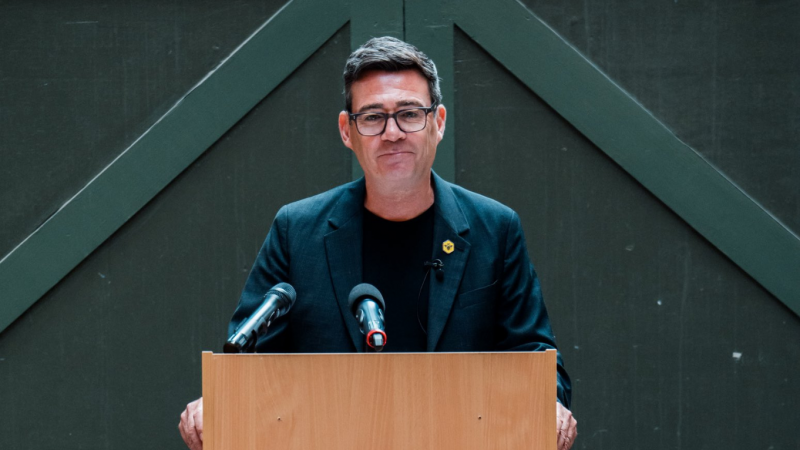

As Andy Burnham takes over from Keir Starmer as Labour’s eighth Prime Minister, much speculation remains about what his agenda will be for government.
With the ‘Plan for Change’ milestones in mind, set out by Starmer at the end of 2024, LabourList spoke to a range of Labour MPs from across the party about what direction they want to see from the party’s new leader in Downing Street, from clean energy to improving opportunity for all.
Kickstart economic growth
Starmer has said Britain’s economy has been put on the right path over the last two years, with growth returning, cuts to interest rates and increases in the minimum wage. His government also saw the biggest package of workers’ rights in decades, with improved sick pay, day one rights to paternity leave and stronger protections for whistleblowers.
However, MP for Liverpool West Derby and member of the Socialist Campaign Group Ian Byrne said that, even with the progress made, Starmer’s government was not radical enough to deal with the challenges Britain faces. He also hit out at a series of unforced errors on issues such as the winter fuel allowance and said that the government’s growth agenda did not deliver for working people.
“The failed formula where [growth] trickles down into economies like Liverpool West Derby is such a false narrative and it’s been absolutely politically toxic. There has been a gentle rollback of austerity, but we’re still constrained by some of the same fiscal ideas.”
The cost of living crisis has dominated voters’ concerns for many years, with a perception among the public that the pressure they face has not eased substantially, despite increases in wages.
Byrne said that, while Burnham has a ten-year vision for Britain, there are several measures he could take in the short term to alleviate some of the pressures people are facing.
In particular, he highlighted the hike to employers’ national insurance and its impact on the ability of some businesses to take on apprentices as a potential area to resolve early on in his premiership.
Amid questions around spending priorities, Byrne bucked the trend of some in the PLP by calling for more money to be poured into struggling communities over increased funding for defence.
“We’ve got a state of emergency in our communities. I’m seeing 14 million people go hungry, millions and millions of kids in poverty. We’ve got on our own doorsteps a huge war to win, and that’s the war on inequality – so I’d love to see the focus on that, because that breeds national resilience.
“There’s got to be a balance. Obviously, we need a viable defence, but if we don’t solve the inequality within our country, the country’s going to stay fractured, it’s going to stay unhappy, and stay angry.”
Making Britain a clean energy superpower
With Ed Miliband championing the government’s energy agenda, Labour has delivered the biggest ever investment in homegrown clean power, launched a publicly-owned energy company, and cut bills for schools and hospitals.
Bill Esterson, MP for Sefton Central and chair of the Energy Security and Net Zero Committee, said the government made “impressive” progress, with solar and wind energy now making up a majority of electricity generation.
However, he also said there have been roadblocks along the way, and said that the transition to net zero needs to support workers, communities and companies along the way.
“The same people who work in oil and gas, the same companies who support through the supply chain, are critical. Both Ukraine and Iran have shown us just how vulnerable we are as a country to imports of energy, in particular oil and gas, which is an argument for reducing our dependence on imports.”
With Burnham set to face questions around his approach toward North Sea oil and gas, Esterson said that Burnham should look to give both Rosebank and Jackdaw the green light as a way of ensuring Britain’s energy security.
“If you want companies to play their part in the energy transition, you’ve got to give them the right signals, so they’re in a position to move to renewables.”
Graeme Downie, MP for Dunfermline and Dollar and member of the Living Standards Coalition, said that while Starmer’s government had done the right things for the long-term on energy security, he would have liked to have seen more pragmatism on short-term measures.
“We’ve done so many of the right long-term things; investment in the grid, trying to accelerate nuclear, encouraging offshore wind in England – all of these things are absolutely the right long-term things. The problem is the payoff is 10 to 15 years down the line.”
He echoed Esterson’s concerns about needing to support energy workers during the transition to renewables – and that approving Rosebank and Jackdaw would improve energy security in the short term.
“I think too often we forget these are our communities, these are Labour communities. These are industrial areas that we need to make sure we don’t make the same mistakes of the horrors of the Tories.”
Become a friend of LabourList and join our community. Our friends support our vital non-factional work and get access to exclusive content and events.
Policing and immigration
Over the last two years, Labour has managed to cut knife crime by ten percent, bring down net migration by more than 80 percent and begin closing asylum hotels across the country.
Jonathan Hinder, MP for Pendle and Clithroe and prominent member of the Blue Labour parliamentary group, credited Starmer’s “more sensible” approach to policing and on keeping the nation’s borders secure, although he said that the party had not “quite got to the right position on those issues”.
As Burnham enters Downing Street and faces challenges with policing, Hinder urged him to put more money behind keeping the country’s streets safe.
“We really don’t spend that much money on our policing and criminal justice system. You look at it in comparison to things like the NHS and it is just absolutely minute. I really would like to see a greater investment in policing.
“I don’t want to turn the taps on in the chaotic way the Tories did when they were trying to undo the 20,000 [policing cuts] but more broadly make it more of a focus, because it really does make a tangible difference to people in their communities.
“I think there needs to be a bit of a reset in terms of priorities – making it clear what is policing, what is not policing. That would be really welcomed.”
Media reports claim that Burnham will axe plans to restrict jury trials to crack down on a backlog in the courts system. Hinder said he also had concerns about the policy and he wouldn’t be disappointed if it is dropped, but was particularly critical of how the proposals were unveiled.
“I suppose where the debate got a little bit lost is the fact that this was talking about reducing the number of jury trials down from something like three percent of criminal trials down to two percent or thereabouts. That got completely lost because we lost control of the announcement.
“I think it speaks to the idea that the criminal justice system is a bit of an afterthought and it really shouldn’t be. I think for a Labour government, it should be as core as other public services and I don’t think we are quite there yet.
On migration, Hinder backed Shabana Mahmood’s approach as Home Secretary, but said the government should go further on addressing the incentives for migrants from crossing the Channel via small boat.
“As long as that is the case, then we’re going to have a problem with this. What I think is probably missing is a slightly stronger deterrent in the first place, which means you make it almost impossible to think you could get on that boat and stay in the UK. I like what [Mahmood] is doing on safe and legal routes, because you start flipping those incentives.”
Breaking down barriers to opportunity
Under Keir Starmer, Labour lifted more than half a million children out of poverty by scrapping the two-child benefit cap, alongside expanding free school meals, free breakfast clubs for primary school children and 4,500 more teachers recruited over the last two years.
Alex Sobel, MP for Leeds North West and founding member of Mainstream, echoed concerns Burnham has expressed around the deindustrialisation of the north of England and that his government must work to address the imbalance.
“We have places that used to be the beating heart of global industry where deindustrialisation has ripped the hearts out of those communities, and I think all the other issues are effectively symptoms of that.”
He also said that the government should ensure that more opportunities are given to children who choose technical education rather than university.
“We’ve got a crisis where there’s a lack of places in many areas for 16, 17 and 18-year-olds at Level 1 and Level 2 for those that the academic route is not the route they’re going to go down. Those are the people that we need for the industrial base of tomorrow to be skilled up.”
Sobel also said that the traditional Conservative approach of “beating people a bit harder and they’ll go and get a job” will not work in tackling the NEETs crisis the country faces.
“I don’t think Andy will do this talking down to young people. We should be talking up young people. They’ve actually got lots of skills that we do not have, particularly in terms of technology. We really need to be investing, encouraging and supporting the future, and I think Andy will do.”
Sobel also expressed his support for Burnham’s vision for devolution to hand power back to local communities across the country.
“We’ve got a very mixed picture but we really should be handing power as close to people as possible.”
Subscribe here to our daily newsletter roundup of Labour news, analysis and comment– and follow us on TikTok, Bluesky, WhatsApp, X and Facebook. You can also write to our editor to share your thoughts on our stories and share your own. The best letters are published every Sunday.
Building an NHS fit for the future
Improving the NHS was a cornerstone of Starmer’s government, with waiting lists down by over 400,000 over the last two years, alongside quicker ambulance response times and more than 2,000 extra GPs.
Dr Beccy Cooper, MP for Worthing West and co-chair of the Tribune Group, said that Burnham’s focus on the health service should be focused on “prevention, prevention, prevention”.
“That should be Andy’s ethos and it is fundamental to what our healthcare system needs, both for patients and the workforce. Our health is our wealth. If you are ill or in poor health, mentally or physically, everything else either stops in its tracks or becomes exponentially harder to achieve.”
Cooper said there should be further devolution in healthcare and that funding should be granted urgently to hospitals affected by RAAC (reinforced autoclaved aerated concrete), so communities can see the upgrading of their hospitals “immediately”.
Burnham has championed reform of social care in the run-up to entering Downing Street. Cooper said that ambition should be an “immediate priority” for his government.
“That has been the case for the past five governments, but all have kicked it down the road. The government has promised a National Social Care Service to finally deliver desperately needed improvements in quality, control, and integration of care. This must be pushed forward from day one.
“We cannot afford to wait any longer. There will need to be a big discussion and then hard decisions, but leaving it as it is is wholly unacceptable.”
One question that will also raise its head once again will be around assisted dying, with Labour MP Lauren Edwards bringing the Terminally Ill Adults (End of Life) Bill back to Parliament for debate in September.
Cooper, who was among those who backed the bill last year, expressed her disappointment that the original bill stalled in the House of Lords due to “delaying tactics” from some peers.
“Three-quarters of the public want to see a change in the law on assisted dying, with over 650 dying people ending their own lives every year and hundreds more travelling abroad for an assisted death. It is now or never.”
-
- SHARE: If you have anything to share that we should be looking into or publishing about this story – or any other topic involving Labour– contact us (strictly anonymously if you wish) at [email protected].
- SUBSCRIBE: Sign up to LabourList’s morning email here for the best briefing on everything Labour, every weekday morning.
- BECOME A FRIEND: If you enjoyed this, why not consider becoming a Friend of LabourList? Help sustain our journalism, and of course Friends do get benefits…
- PARTNER: If you or your organisation might be interested in partnering with us on sponsored events or projects, email [email protected].
- ADVERTISE: If your organisation would like to advertise or run sponsored pieces on LabourList‘s daily newsletter or website, contact our exclusive ad partners Total Politics at [email protected].



More from LabourList
Delivering in local government: How Labour is building a better Britain everywhere
‘Changing our voting system is fundamental to Burnham’s agenda’
‘Labour has a chance to make the socio-economic duty mean something’