

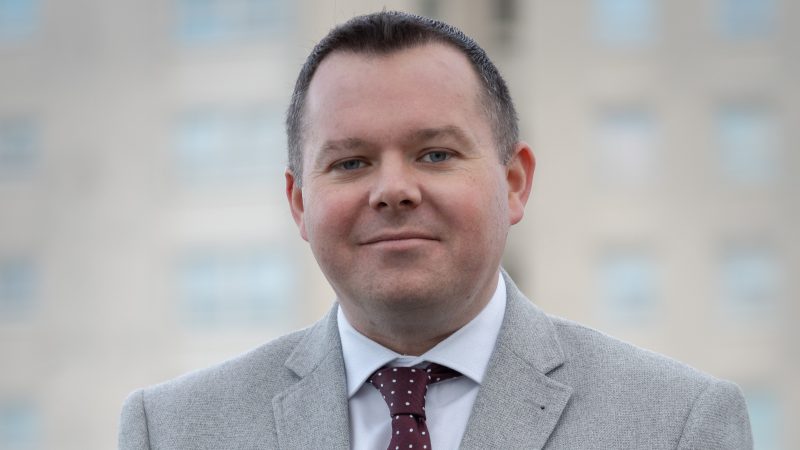

This is the third of our pitches from those standing to be the leader of Scottish Labour. LabourList has approached all declared candidates to give them the same opportunity to make their case.
This contest has to be about more than how Scottish Labour talks about itself. It has to be about who we are for, where power sits, and whether we are serious about changing the lives of people who have stopped believing politics can deliver for them.
My answer is simple. Scottish Labour should be the party of more money in people’s pockets, more power in people’s hands, and more wealth kept in the communities that create it. That means good work, affordable homes, strong local services and an economy that rewards the workers and wealth builders who keep Scotland moving.
That is the change I am standing for. Not a tidier version of the same politics. Not another argument trapped inside the Holyrood bubble. A Labour Party rooted in places again, brave enough to build, serious about work, and ready to hand power back to the people.
Scottish Labour succeeds when we stop obsessing about ourselves and start pushing power outwards.
Not to the bubble. Not to the political elite. To people, communities and the places where lives are actually lived.
That is why this contest cannot become one long argument about Scottish Labour.
We have to sort out how the party is run and how much freedom it has to speak for itself, but that cannot be all we aspire to.
If we spend the summer looking inwards, we will have missed the scale of the task.
The result in May was damning. After 20 years of SNP government, Labour returned 17 MSPs and finished level with Reform. Public services are crumbling, councils have been cut to the bone, and the scandal-ridden SNP have given us plenty of chances to beat them. We did not.
Voters want us to change, and we have to show we can change.
Become a friend of LabourList and join our community. Our friends support our vital non-factional work and get access to exclusive content and events.
The big picture is that Scotland is short of homes and short of work. Councils are holding together care services and schools while decisions that shape them are taken further away. These are large problems. They need ideas with some force behind them and a party with the courage to take decisions.
Labour needs ideas and arguments that are fit for the challenge of our time and up to the task of transforming our country. But this contest cannot descend into navel-gazing.
Our moral purpose is demonstrated in action. It is shown in the house that gets built, the job that stays in the town, the care visit that happens on time and the bus that gets someone to work. What must end is the idea that people require translation before they can work out whether we are on their side.
I have knocked doors all across Scotland, from East Kilbride to Aberdeen and beyond. People know their lives have changed. Large employers have left Scotland’s towns. Now people watch their children do the same because they cannot find a job they can build a life on or a home they can afford nearby.
Local services are unreliable. You cannot always get an appointment when you need one. You cannot always get a bus to work. You cannot assume your town centre will have the shops, banks, leisure facilities or public services it used to have.
We need to listen to those fears and concerns without explaining people’s own lives back to them. We need to speak the language people actually use, and fix the problems they actually have, not the ones we imagine in order to make ourselves feel better.
I have spent the last four years leading South Lanarkshire Council. We made swimming free for under-16s, helped families with household costs and delivered the best paid home care workforce in Britain. That is action on the everyday things people need and the services they notice when they are not working. We tried to give people a little help and a little hope.
We also set difficult budgets and kept services running through them.
That is where my politics comes from.
Devolution moved power from London to Scotland, as it should have done. Too much of it stopped at Holyrood. Holyrood has pulled decisions into the centre while councils have taken on more duties with less room to act. The First Minister announces a target; local government has to find the land, the planners, the carers and the money.
Greater Manchester cannot simply be lifted and dropped into Scotland. But Andy Burnham’s approach of starting with the place itself is worth learning from.
Can people get to work? Can they afford to live nearby? Does skills funding match the employers down the road? Is public money building local wealth or leaking out of the community? Are we giving people power over the decisions that shape their lives?
That is the kind of politics Scottish Labour should be talking about.
Housing would be an early test. Councils know where a scheme is stuck and what is missing, yet they are expected to meet national targets with uncertain funding and under-resourced planning departments. Give councils and housing associations enough certainty to acquire land, borrow and build over several years. Then judge the result.
The same principle applies to work.
North Sea oil and gas supports tens of thousands of skilled jobs. Scotland’s energy workers deserve better than being treated as collateral damage in a debate conducted miles away from the communities that depend on those jobs.
Jackdaw and Rosebank should be part of a real transition to a new industrial future for the North Sea. These projects can provide the world-class jobs Scotland needs to move from the first generation of North Sea production to a second.
There are huge opportunities for Scotland in offshore wind, hydrogen and carbon capture and storage. The story of the North Sea does not need to be a story of decline. It can be a story of industrial revival, if we protect skilled workers now and invest seriously in the industries of the future.
Grangemouth demonstrates why we need a politics that is alive to people’s fears, but also willing to stand up to corporate power.
Let us be clear. Corporate failure put jobs at Grangemouth at risk, then used those jobs to hold both of Scotland’s governments to ransom. That cannot and must not continue.
There will be no just transition if the workers and communities who built Scotland’s energy industry are told to carry the cost of change themselves. Transition only means something when the new job exists before the old one disappears.
That means better skills passporting, greater access to retraining, stronger support for the supply chain and a serious industrial strategy linking oil and gas, renewables, manufacturing, ports, engineering and the grid.
It means using public contracts and investment to build the industries that follow, and making sure Scottish firms win a much larger share of the fabrication, maintenance and supply-chain work.
It also means building community wealth. The wealth created in Scotland should do more to support Scottish jobs, Scottish businesses, Scottish communities and Scottish public services.
The next Scottish Labour leader will have to make that case at Holyrood and in London. A Labour government at Westminster gives Scotland opportunities which we should use. It does not remove the need for Scottish Labour to speak clearly when Scottish jobs or services are at risk.
I may be new to the Scottish Parliament, but I am not new to leadership. I led one of Scotland’s largest local authorities with a £1 billion budget and a 16,000-strong workforce, and I made it work.
Schools still had to open on Monday, care visits still had to happen, and the numbers still had to add up. I do not regard that as lesser political experience. It is exactly the kind of experience I would bring to the leadership.
Scottish Labour needs internal change. The country cannot be an afterthought to it.
I am standing because I want this contest to deal with local wealth and local power, the homes Scotland is not building, and the work we keep promising will arrive later.
If Scottish Labour wants to win again, we have to stop talking to ourselves. We have to show we are serious about changing people’s lives and handing power back to the people.
Subscribe here to our daily newsletter roundup of Labour news, analysis and comment– and follow us on TikTok, Bluesky, WhatsApp, X and Facebook. You can also write to our editor to share your thoughts on our stories and share your own. The best letters are published every Sunday.
-
- SHARE: If you have anything to share that we should be looking into or publishing about this story – or any other topic involving Labour– contact us (strictly anonymously if you wish) at [email protected].
- SUBSCRIBE: Sign up to LabourList’s morning email here for the best briefing on everything Labour, every weekday morning.
- BECOME A FRIEND: If you enjoyed this, why not consider becoming a Friend of LabourList? Help sustain our journalism, and of course Friends do get benefits…
- PARTNER: If you or your organisation might be interested in partnering with us on sponsored events or projects, email [email protected].
- ADVERTISE: If your organisation would like to advertise or run sponsored pieces on LabourList‘s daily newsletter or website, contact our exclusive ad partners Total Politics at [email protected].



More from LabourList
Labour triumphs against Polanski, but the Green threat remains
Delivering in Government: your weekly round up of good news Labour stories
Labour members willing to accept Green defections, but not Tories or Reform – poll