


Rowenna Davis has managed to cultivate hundreds of thousands of views across her social media channels while campaigning to be Mayor of Croydon. From a brief look, it is easy to understand why. She has successfully paired an effective digital strategy that is designed to thrive across algorithm-driven platforms, alongside a campaign routed in a clear message of hope and optimism for a better Croydon.
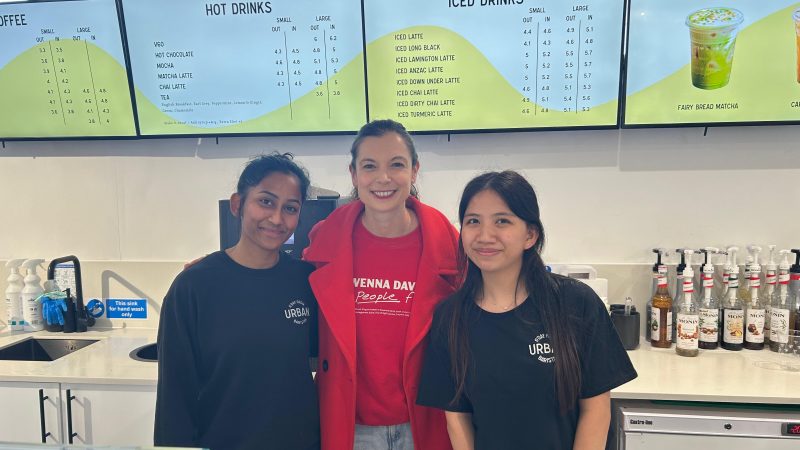
I met Rowenna in a local coffee shop near East Croydon station. She was immediately recognisable from the iconic Labour-red coat I have seen in many of her videos. Even that demonstrates the level of thought being put into the considered choices at the heart of her campaign’s unique identity. It was not only me who recognised her. Staff behind the bar in the coffee shop immediately knew she was “running for Mayor” and asked her for a photo to send to their boss.
This was not the only occasion the Mayoral candidate was stopped for a photo throughout my hour with her. It was immediately apparent that not only had she managed to gain a level of recognition status with the public who would be voting for her soon, but also popularity. People were going out of their way to shake her hand and thank her for what she was doing for the area – this all before being elected. Nor was this exclusive to those who were simply going about their daily activities in Croydon’s centre. Croydon’s public servants from the man operating the street sweeper to the police on the beat all knew Rowenna well enough to call her by first name and stop for a quick passing chat. She was happy to speak to anyone who wanted to speak to her – all without this ever feeling like it is only for the purpose of asking for votes, or through a more cynical lens, for the benefit of the media.
Reflecting on being recognised in public and the breadth of people engaging with her campaign, Davis tells me “it’s lovely to feel known and the people stopping me… are not the normal, like, conventional high turnout voters.” She describes widening the reach of her campaign beyond traditional political engagement as managing to reach “a lot of very young people who’ve never voted before.” She attributes this to her digital engagement, “this is the joy of social media as you reach people who wouldn’t normally be involved.”
READ MORE: Watch Labour’s uncensored attack ad exposing extreme views of Reform politicians
“I’m definitely learning and making mistakes [in relation to social media]” Davis tells me, as she acknowledges the journey she has been on with campaign strategies.
“When I started this campaign, if you’d have said to me ‘you have to choose print or digital and you can only have one’, I’d have gone with print. the old out-cards, direct mail… but now the experience of this campaign has shown me I’d take digital every time.”
“When people stop me and say hello now, it’s almost entirely because they’ve seen me online.”
I wondered what prompted this evolution of preference for her chosen campaigning technique? “I’ll show you” she said.
We turned a corner to see a combination of derelict buildings and a large boarded up area. Davis asked me to look through the gap in the fencing and tell her what I saw. It was, as she knew, a giant hole of rubble and emptiness surrounded by tall abandoned buildings. She explained to me, her most successful video had been filmed here, sat on the upper deck of a bus which provides a clearer view over the boards. The bus stop that provides this scenery is announced as “Croydon town centre” over the tannoy. In Davis’ video, she tells the camera that when the bus announces ‘Croydon town centre’ “all we see is a giant hole where our heart should be”, blaming the neglect on companies abroad who maintain ownership of the abandoned sites while not supporting any redevelopment in the town centre.
She tells the camera: “If I become Mayor, I will use every power we have to take back that land and make sure its used for new shops, new homes, new investments, new jobs that this town desperately needs, make sure you vote for that in May.”
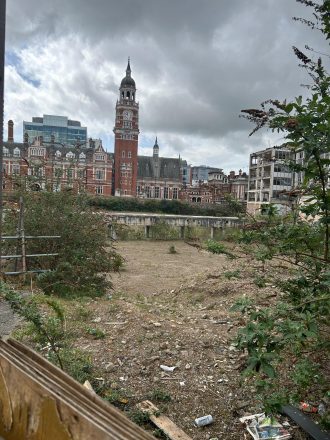
Davis’ video received 123,000 views on Instagram. This strategy of providing optimistic solutions in short form video focused on hyper-local issues has, so far, proved effective.
We walked towards the high street. On the way, she took the time to provide some context around Croydon’s story and how it drove the messaging of her campaign. Croydon was once “the place to be” she told me, however “the story over the last 30 years has sadly been one of, like, huge decline.” To paint this picture further, Davis likened Croydon of the past to Oxford Street in London around Christmas time – full of beautiful light displays and bustling with people. Croydon now was changed, if one stepped off the train and expected a winter wonderland, “instead of that beautiful Christmas-like scene, you had Gotham City.”
Her campaign was about restoration, retuning the town to its former glory. The political stakes were simple for Davis: “do you want the town centre to continue to die? Or do you want to get it back?” – this was the essence of her campaign. How did she plan to regenerate a town that had been in decline for so long? The candidate pointed to derelict buildings as we walked and explained the lack of care private owners had placed in the sights, neglecting over maintenance.
“We’ll go on to land commission… and we’ll look at the worst 50 sites across Croydon.” A dual approach of cooperation and enforcement was required to restore the town centre. For those who wish to continue investing in the area, making their business part of the journey back to a better Croydon, “you have no better friend than me… but if you don’t act, we also need to up the stakes.”
Davis has a clear idea of enforcement mechanisms that may need to be used. “If we need to send in the health and safety inspectors every week… and if we need to compulsory purchase all this, that’s what we’ll do.”
Become a friend of LabourList and join our community. Our friends support our vital non-factional work and get access to exclusive content and events.
From the array of visible decay of buildings and public spaces Davis was showing me, it was clear Croydon would take a significant amount of money to reverse the damage done from years of neglect. Was the borough financially in any position to fund the scale of change her campaign was promising?
The mayoral candidate made no pretence. “We have right now… a debt crisis in the council,” she responded plainly. Nearly a fifth of the authority’s annual budget, she said, was already being swallowed by servicing historic borrowing. “Seventeen per cent is debt interest. Not paying down the debt, just debt interest before you spend a penny on anything else.” For a borough trying to rebuild confidence in itself, that financial reality presents an immediate obstacle. The question, then, was not simply whether Croydon needed renewal, but who could realistically pay for it.
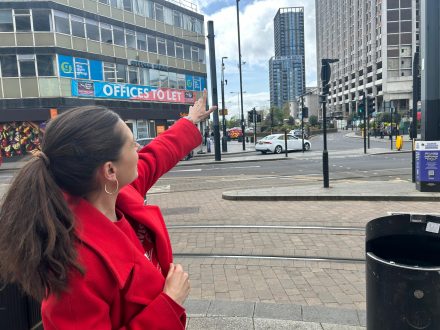
Her answer was that the council could not do it alone. “There is no scope for the council to buy land,” she said. Any serious regeneration would have to be driven through partnerships with outside investors willing to commit to the borough long term. For Davis, that changes the nature of the mayoral role itself. “A good mayor doesn’t spend all their time in a council office,” she said. Instead, she sees the job as part political leadership, part ambassadorial sales pitch – persuading developers, businesses and institutions that Croydon is worth believing in again. She told me she had already begun those conversations, meeting “almost a dozen” potential investors before a single vote had been cast.
Yet throughout the conversation, Davis returned less to economics than to emotion. In a political moment where anger often dominates, her campaign is trying to offer something more difficult. The messaging is not just identifying decline, but convincing people that decline is not irreversible. Walking through a town centre she believes many have given up on, Davis appeared to understand that before Croydon can be rebuilt physically, it first has to believe it can be rebuilt at all.
It was clear this message of hope was resonating with voters, many of whom wanted to thank Davis when they saw her for “what she is doing for the area”.
Davis presents politics as inseparable from storytelling, arguing that policy only becomes persuasive when it is rooted in a broader narrative. As she puts it, “you’ve got to have a politics.” For her, the central political task is “to earn trust” with communication serving not simply to promote ideas but to help do so. She describes that trust as emerging through three pillars of the storytelling in her own campaign. Personal identity, practical policy, and digital reach.
What’s important is to balance the personal connection with the political explanation. Social media remains necessary, but only as the medium. She explained “it was the story of me, and the story of the place, and the policy, that made the social media work.”
She also seeks to distinguish herself from more conventional populist rhetoric, often recognised in the Greens and Reform. Davis acknowledged that both parties capitalise on public anger and frustration towards politics that has consistently let them down. “They are angry. And they reflect a legitimate anger,” but argues that grievance on its own, as offered by the Greens and Reform, is insufficient. Instead, she describes her own approach as an effort to “take the anger… and add some hope and a plan.”
Subscribe here to our daily newsletter roundup of Labour news, analysis and comment– and follow us on TikTok, Bluesky, WhatsApp, X and Facebook. You can also write to our editor to share your thoughts on our stories and share your own. The best letters are published every Sunday.
“Hope is the word,” she says, while acknowledging the pressure that follows: “I feel all the time, like, damn, we’ve got to deliver.”
As an English teacher before running to be Mayor, I was interested to know which book she would recommend for LabourList readers. “Of Mice and Men is a great place to start,” with its relevance for the current moment, offering insight into “what happens to people in economic decline when the state fails them and the market fails them.”



More from LabourList
‘Arts for young people is key to hope’
‘It’s time to end the university-first approach to opportunity’
‘The government must reform vehicle taxation in the next budget – or risk losing out on more than £60 billion’