

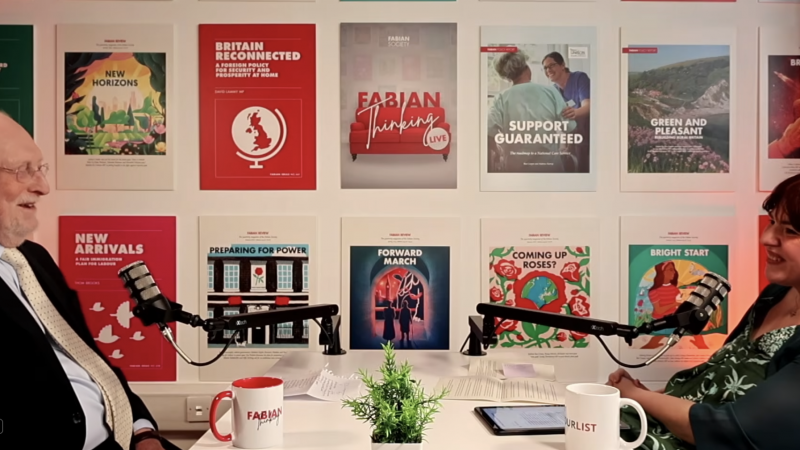

Neil Kinnock has been at the forefront and behind the scenes of Labour politics for decades. If you were to put together a montage of the key moments for Labour – good and bad – you would probably see Neil in there somewhere.
The ‘winter of discontent’, losing to Thatcher in 1979 and the disastrous loss in 1983, the miners’ strike, the pain of 1987 and much worse 1992. Neil was there – leading from the front. Whilst the 1997 victory was the catalyst for the minimum wage and Sure Start, Neil sowed the seeds of change that enabled that win. When the Coalition and Tory governments stripped away so many of the Labour achievements we took for granted, Neil was watching on with horror.
With such a storied career (and such a storyteller) it can be hard to know where to start. And those Friends of LabourList who watched live (the full video will be released at a later date) will know that any question asked of Neil will never lead to just one answer or just one anecdote – but to a wild canter through the history of the Labour movement with detours through dances in his Bedwellty constituency, his 1980s motor and the internal politics of the NUM among many other topics.
READ MORE: ‘A piece on advice’
Given all this, you might expect Kinnock to be the kind of politician who will tell you that it’s the journey that matters more than the destination. But this would be wholly wrong. When asked what his biggest unfulfilled wish was his immediate response was: “There’s only one answer to that, and that’s not winning at least one election to get a Labour government.”
When he talked about ambition, when he talked about what he wanted to achieve the way that he said it was not about him becoming Prime Minister but as he went on to say: “It’s about more than one bloke – or one woman – getting this job at the head of the table.” He added: “It’s about winning elections for our cause.”
It is that sense that it is not about the purity of the cause but the electoral effectiveness of it that has been the core theme of what never became Kinnockism – but would definitely be the defining characteristic of anyone who called themselves a Kinnockite.
Whether it’s one-on-one or in a conference hall, Kinnock is an inspiring speaker. In fact, as we discussed, there aren’t many people who have not just one but three speeches that are still quoted by other decades later.
What is fascinating is that he is able to make a passionate case using words like pragmatic, sensible, rational – all words he used as better terms when asked for a definition of the ‘soft left’ (a term we both agreed that we disliked). The ability to make a compelling and passionate case for democratic socialism using terms that you would never find on an inspirational poster, and do so in a compelling way, is a skill that Labour needs to rediscover – and fast.
On the soft left (or “sensible left” as he preferred to call them), he said the key thing to remember is that while they can be organised (and in my view as you will hear in the interview, disorganised) they are not a faction. This might feel from the outside like splitting hairs. But I believe what he means by this is again in his passion for how we do democratic socialism in a practical way. Those he would class in this bracket might range quite far across the centre left. But it is their approach to how those values can be applied in action that counts. And their willingness to change their mind about the personnel and the policy tools but never lose sight of the goal.
We talked about how Labour can be a party that has robust internal debate without these descending into angry factionalism. He acknowledged that this is “very, very difficult”. For him it is about what attitude you come into the debate from. “If people or groups start out with fixed stances and their policy attitudes… their alignments with individuals in the Party or titles have taken on an almost religious devotion, getting productive exchange can be difficult.” But he believes the way for Labour members who understand their ‘comradeship’ “they take each other seriously, but not earnestly and they will recognise that the purpose of engaging in dialogue… is to get a better outcome.
If you’re both well-motivated (and that’s a pretty big ‘if’ sometimes) then you are seeking a result that is acceptable to both and will be better than either of you have committed yourself to before.”
It is this consistent focus on outcomes that is at the heart of Kinnock’s socialism. It is never about the success of an internal grouping; it is never about being wedded to a specific approach or policy – however iconic. Instead, it is about Party members working together for the good of the people to improve the lives of those we seek to serve.
When talking about the achievements of the New Labour years, he is clearly very proud of what was done including “the huge investments in education and health, Sure Start, massive reductions in pensioner and child poverty”. However, he also talked about his frustration that even these arch communicators were not telling the story of what they had done and as he saw it, the public started to take those achievements for granted to “believe that it was coming anyway” rather than being led to understand “it was the consequence of having a Labour government applying its serious progressive purposes, its values”.
Become a friend of LabourList and join our community. Our friends support our vital non-factional work and get access to exclusive content and events.
It was a passion for communication that led to the changes in organisation and communications from the Labour Party that brought it, late to the party, into the television age under Kinnock. It was these changes that eventually led to New Labour and the landslide victory of 1997.
Kinnock isn’t without his criticism of what has happened since Labour came to power in 2024. He described Labour’s communications in government as “almost absent”, adding: “I am sure there are people striving like hell. It’s not working. It’s got to be massively improved.”
Equally he says that “the good things that have been done since July 2024 have been obscured by “stupid, wrong, un-Labour things that were done which people remember very clearly because they felt seriously – desperately in some cases – let down.” He cites the winter fuel allowance and the delay in scrapping over the two-child benefit cap as examples.
From all my reading, from all my researching, from all my watching of old speeches I think the reason that Kinnock remains such a giant figure for the Labour movement is twofold.
Firstly, while he may change what the policy delivery mechanism are, he has never changed in his principles. How those can be applied has to change with the circumstances and the times. The environment in which we find ourselves. So devotion to individual policies or even individuals is not socialism in action – its dogmatism.
But the other part is the man loves an argument. And let me be very clear what I mean by that. Kinnock will have a fight if a fight is needed. Frankly there are clearly times when he relished doing so (and revels somewhat in the memories). But it is in making an argument – from a core set of principles and using every tool of persuasion at his disposal – that Kinnock comes alive. And he comes alive often.
Subscribe here to our daily newsletter roundup of Labour news, analysis and comment– and follow us on TikTok, Bluesky, WhatsApp, X and Facebook. You can also write to our editor to share your thoughts on our stories and share your own. The best letters are published every Sunday.
That art of persuasion – not just communicating a message that boils down to a three line slogan or focus tested mission statement – but making a principled, coherent stance that can demonstrate a central thread that doesn’t just parrot Labour values but makes the deeper case for them. That art is what Labour needs now more than ever.
The old adage is “never meet your heroes’. Well, this week I met the man who has inspired my approach to politics for my whole life. And I say to anyone who says that – get better heroes. And then meet the hell out of them.



More from LabourList
‘From solidarity to accountability: why Labour must stand up for Hong Kong’
‘Why ‘Hugh’s Law’ should be the next step for working families’
Good growth in every postcode 14th October 2026