

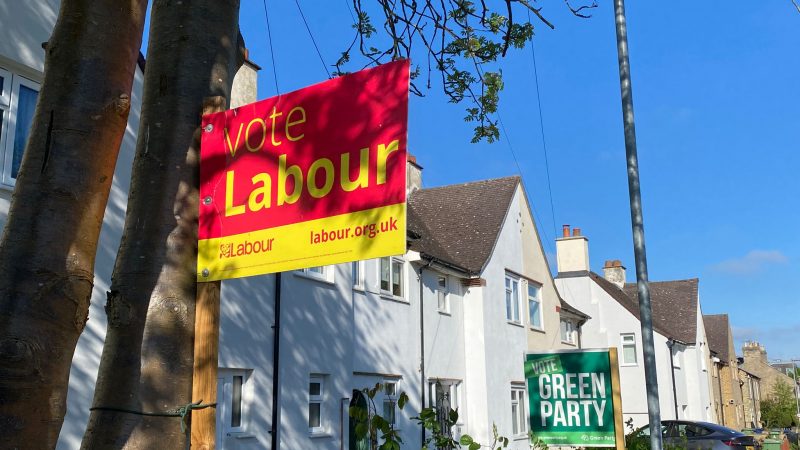

Just how worried should Labour be about the Greens? It is a question that Labour strategists are rightly grappling with.
Victorious in the Gorton and Denton by-election, now riding ‘high’ in the polls, there has been much discussion around whether the Greens could act as a ‘Reform of the left’ in the coming years. The threat is real. Might the Greens cost Labour the next General Election by taking progressive votes from them? Could they even replace Labour as the main progressive party in Britain long term?
The Greens are on the march
It is early days, but we are seeing mounting evidence that the Greens pose a potentially grave threat to Labour. Our Ipsos Political Monitor shows them at 17% in back-to-back months. Our April data shows them just two points behind Labour – winning over one in five 2024 Labour voters now. Other pollsters have shown them second overall.
But dig deeper and it is less the headline, and more the structure of their support, that should worry Labour most.
READ MORE: Two-fifths of Labour members consider Greens biggest threat to Labour, poll reveals
Our research at Ipsos shows the Greens in the lead with those aged under 45 and comfortably ahead with those under 35. This is driven by the support of younger urban graduates, which has significant crossover with Labour’s modern base. In fact, some 4 in 10 Labour voters from 2024 now tell us they are considering voting Green at a future General Election. The Green threat to Labour isn’t a hypothetical future one, it is here today.
What explains this rise in support? A desire for radical change, turbocharged by strong concern about the cost of living; something of great concern to younger voters in particular. Ipsos polling in England ahead of the local elections shows the cost of living is the number one issue driving the votes of those under 35. Whereas for those aged 55+, the condition of streets, roads and pavements and crime and policing are more important. Meanwhile, whilst housing ranks 10th overall on the list of voter priorities at these elections in England, it is 4th for those aged under 35.
Become a friend of LabourList and join our community. Our friends support our vital non-factional work and get access to exclusive content and events.
Public frustration at the pace of change appears to be hurting Labour. Ipsos polling in November showed half of the public want radical change but only 4% of this group trust Labour most to deliver it. Those identifying on the left of politics were as likely to trust the Greens (31%) to deliver the type of change they wanted as Labour (29%). This is worrying for a government whose central promise in 2024 was delivering just that.
Opportunity knocks
The coming local elections offer the Greens a real opportunity to consolidate support and establish geographical footholds ahead of a future general election. London, a Labour bastion, will be a key target, with our data showing almost half of Londoners (49%) at least considering the Greens. More generally, Ipsos polling reinforces the threat posed to Labour. Almost 6 in 10 under 35s (58%) are considering the Greens for the locals, plus 54% of graduates and 55% of private renters. That is the same pool of voters that Labour would naturally be hoping to win over.
The Green ceiling?
But how high can the Greens go? Is there a ceiling to their support?
Older voters, typically more reliable at turning out in elections, are feeling less Green. Ipsos polling in March showed 52% of those aged 55+ have an unfavourable opinion of the party and our recent local elections polling showed only 1 in 4 of this group considering voting for them at the upcoming elections. Furthermore, whilst their potential pool of support in certain areas of England looks strong, they are in a weaker position in Scotland and Wales. Both of which have elections in May.
A challenge smaller parties often face is being ‘squeezed’ when a general election approaches. Labour will hope to ‘squeeze the Greens’ in future by positioning any general election as a binary choice between a Labour government led by Keir Starmer and a Reform UK government led by Nigel Farage. Ipsos polling this month shows that 7 in 10 of those considering the Greens prefer a Labour government led by Starmer to a Reform government led by Nigel Farage. This strategy could work.
The leadership question
Public perceptions of Zack Polanksi will be key in pushing back. Polanski has done an impressive job growing the appeal of the Greens but the public have their doubts about him too. Whilst he is generally more liked than Keir Starmer, the public don’t yet see him as a credible Prime Minister-in-waiting. In fact, 7 in 10 tell Ipsos they think it is unlikely Zack Polanski will win the next General Election and just 16% think he has what it takes to be a good Prime Minister. For the Greens to ever truly replace Labour that would need to change, especially in a world where national security and defence are growing as issues of public importance.
Real, serious but not inevitable
Perhaps then the Greens are not inevitably an existential threat to replace Labour as the party of the British left quite yet. They have hurdles to overcome. To truly breakthrough in such a way they would need to broaden their geographical support and to establish themselves as a national player in such a way that it is difficult for Labour to squeeze them at a future General Election.
And yet Labour should take the threat from the Greens extremely seriously.
They may be in the early stages of establishing themselves as a national political force but the potential is clearly there to do so. The core of potential Green support – younger, urban, progressive graduates, motivated by issues like the cost of living, housing and a desire for radical change, intersects with Labour’s core support in such a way that, if the Greens can win them over and keep them, the threat to the Labour Party in the long term could be existential.
May’s elections won’t decide the long-term trajectory of such conversations, but they do provide the Greens with an opportunity to show they are here to stay. After which Labour may well have some soul searching to do as to the appropriate policy response.
Subscribe here to our daily newsletter roundup of Labour news, analysis and comment– and follow us on TikTok, Bluesky, WhatsApp, X and Facebook. You can also write to our editor to share your thoughts on our stories and share your own. The best letters are published every Sunday.



More from LabourList
Letters to the Editor – week ending 11th October 2026
‘Playing it safe on Europe is the riskiest thing Labour can do’
‘Jack Charlton and Labour’s rural tradition’