

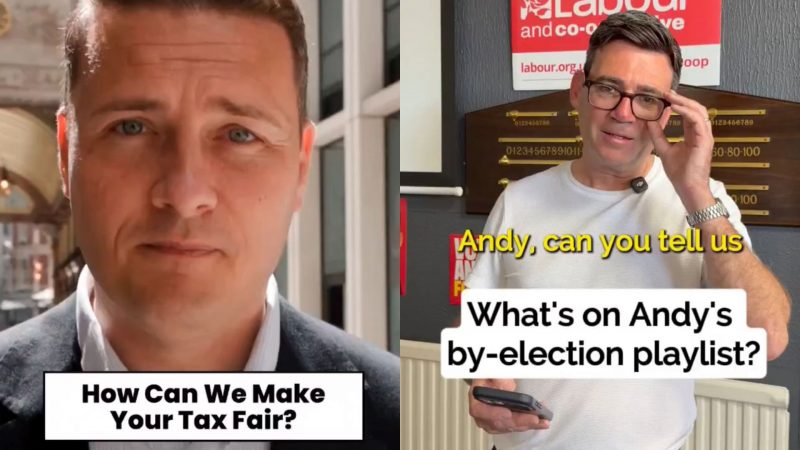

There is not currently a vacancy for Labour leader – but it would be foolish to pretend there isn’t a (currently informal) contest taking place.
Starmer seems set on fighting to stay in his position, while two thorns in his side battle each other for all to see. This is unfolding in newspaper op-eds and clipped social media videos with carefully calibrated interventions on the political argument of the day.
If anyone doubts this, the recent responses of Wes Streeting and Andy Burnham to Tony Blair’s intervention on Labour strategy offered a reminder.
READ MORE: Who benefits from Blair’s essay?
Blair’s essay itself hardly broke new ground, as much as his reputation alone prompted it to be heavily discussed across Labour circles. What mattered politically was not the content of the intervention but the reaction it generated. Within hours, Streeting and Burnham had both felt they had to enter the conversation. Not merely to disagree or agree, but to stake out their positions.
Streeting chose The Guardian, Burnham, The Observer. Yet the interesting development lies not in the newspapers themselves but in what happened around them.
Neither man treated the article alone as the intervention, which in years prior would have been ‘the done thing’. The article served as the anchor for a broader communications strategy. Clips appeared online. Arguments travelled through social feeds. A newspaper column now acts less as a final statement than as source material for digital circulation.
This marks a substantial shift in how Labour succession politics works.
Historically, Labour leadership contests rewarded internal legitimacy above all else. Candidates cultivated constituency parties, won over unions and persuaded activists who formed the selectorate.
Social media has ceased to function as a supplement to Labour politics and become one of its principal battlegrounds. Generating online enthusiasm can mobilise real-world organisation and reshape internal debate. Leadership contenders no longer rely solely on endorsements from MPs or union leaders. They need attention and reach, alongside a recognisable political identity that the Labour party, and wider country, would be willing to accept.
Streeting and Burnham understand this instinctively.
Since leaving his role in the cabinet, Streeting has become a free man. The constraints of collective cabinet responsibility no longer prevent him from demonstrating the exceptional level of political flair he so clearly has. He has taken to his car for a road trip series, filming himself as he tells viewers which destination in the country he is visiting next. All chosen with intent, to speak to people that were once nailed on to come out for Labour, who now feel the party has left them behind.
Become a friend of LabourList and join our community. Our friends support our vital non-factional work and get access to exclusive content and events.
Streeting has also taken to discussing complicated topics for Labour on his social channels. Interventions on Europe and the need to change our tax systems would appear to be in line with arguments placed forward by the left of the party – which typically has not been seen as his brand.
On the other hand, Burnham’s by-election is the perfect zoo – with all eyes on the political animals. It allows Greater Manchester’s Mayor to communicate his ideas, and – perhaps more importantly today – his personality, to the nation. Operating from outside Parliament gives him the advantage of being nowhere near critiques of the government. Burnham is successfully (for now at least) running the ‘change’ narrative again, choosing to make himself the symbol of this powerful political force.
Daily campaign updates are a banker for views, with his first generating 457,000. Yet this is nothing compared to the 2.8 million he has received on his introductory video to his campaign.
On social media Burnham has also taken on some of Labour’s more uncomfortable talking points. His second campaign update video saw him discuss grooming gangs with confidence in his own position. This is something many voters across the country care deeply about.
Neither politician currently stands in a formal contest, yet both behave like politicians engaged in one.
Until we have a formal contest, Streeting will continue to sharpen a profile built around competence, displaying the extent of his political antennae. Burnham will keep cultivating a politics of authenticity, regional credibility and soft populism. Both know they must move between mainstream and social media with fluency because Labour’s future contests will demand exactly that.
Leadership campaigns have, in truth, always started below the surface long before a traditional contest was contemplated. But in this social media age, the lines are even more blurred. What has become clear is that his contest has already begun. Streeting and Burnham understand the new rules better than most.
Subscribe here to our daily newsletter roundup of Labour news, analysis and comment– and follow us on TikTok, Bluesky, WhatsApp, X and Facebook. You can also write to our editor to share your thoughts on our stories and share your own. The best letters are published every Sunday.
-
- SHARE: If you have anything to share that we should be looking into or publishing about this story – or any other topic involving Labour– contact us (strictly anonymously if you wish) at [email protected].
- SUBSCRIBE: Sign up to LabourList’s morning email here for the best briefing on everything Labour, every weekday morning.
- BECOME A FRIEND: If you enjoyed this, why not consider becoming a Friend of LabourList? Help sustain our journalism, and of course Friends do get benefits…
- PARTNER: If you or your organisation might be interested in partnering with us on sponsored events or projects, email [email protected].
- ADVERTISE: If your organisation would like to advertise or run sponsored pieces on LabourList‘s daily newsletter or website, contact our exclusive ad partners Total Politics at [email protected].



More from LabourList
‘Arts for young people is key to hope’
‘It’s time to end the university-first approach to opportunity’
‘The government must reform vehicle taxation in the next budget – or risk losing out on more than £60 billion’