

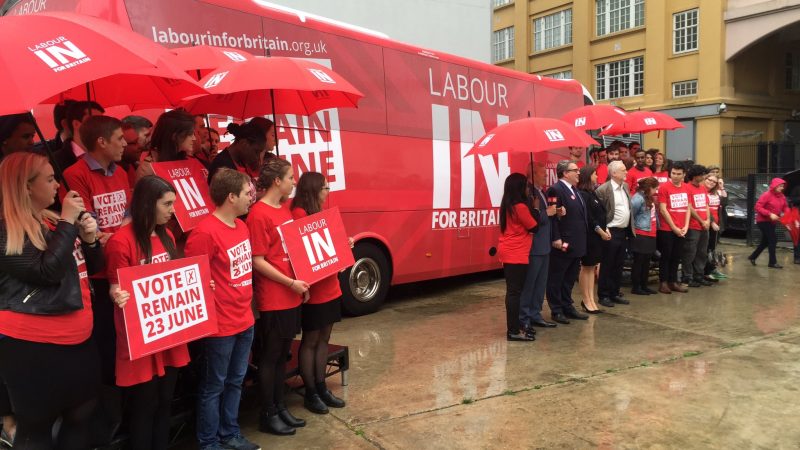

Ten years on, the Brexit referendum remains one of the most consequential events in post-war British political history. It toppled prime ministers, redrew Britain’s electoral map and transformed the UK’s relationship with the EU. For Labour, Brexit was never simply a contest between opposing parties, but a battle that was also fought within its own ranks.
While much of the discourse about 2016 is framed as a clash between the pro-European and eurosceptic factions of the Conservative Party, Labour also entered the referendum with divisions of its own. Not only were its voters, and to a much lesser extent its MPs, split over competing visions of sovereignty and internationalism, but questions were raised about Jeremy Corbyn’s support for Remain during the campaign, which many saw as lacklustre.
A decade later, LabourList spoke to five prominent Labour voices who found themselves on opposite sides of the argument. Their reflections reveal not only how Labour experienced the referendum campaign, but how its divisions over Europe continue to shape Labour’s and British politics today.
‘I tried hard to persuade Miliband that we should say we’d have a referendum’
Questions over Brexit began when David Cameron promised an in-out referendum on EU membership in the run-up to the 2015 election.
Graham Stringer, a long-standing eurosceptic in the PLP, said he was among a group of Labour MPs calling on Ed Miliband to make a similar pledge in the run-up to the general election.
He said: “I tried very hard to persuade Miliband that we should say we’d have a referendum. His words to me were ‘I don’t want to spend my first five years in Downing Street campaigning about the European Union’.
As part of the Labour for a Referendum campaign, the late Labour donor John Mills commissioned polling that suggested such a commitment would shift the dial in dozens of constituencies and prevent Labour seats from going to the Tories.
Brendan Chilton, the campaign’s director, said: “We presented this information to the party and said this is significant – and it wasn’t a one-off poll; it was a series of polls with field research as well. The party said no, and funnily enough one of the seats that was going to be affected was Morley and Outwood, which was Ed Balls’ seat.”
Labour’s Eurosceptic past
Once the stage was set for an in-out referendum on membership after the Tories’ victory in 2015, Labour dropped its opposition for such a poll, with the party supporting the campaign to remain within the EU.
Labour had not always been so supportive of the European project, having called for Britain’s withdrawal from the EEC in 1975, although Harold Wilson and his Cabinet backed continued membership.
Stringer said: “Most of the Labour Party and trade union movement were in favour of coming out – you’d find it difficult to get selected as a parliamentary candidate if you were in favour of staying in.”
He said that he still holds the same principles that led to him voting out in 1975.
“I believe in national democracy and the fundamental right of being able to throw out the people who make our laws in elections, which you can’t do with the European Union.”
Former MP Alan Johnson, who worked as a postmaster at the time of the 1975 referendum, said Wilson’s approach was critical in helping secure a victory for the ‘yes’ side in that vote.
“He [Wilson] played that brilliantly, because he got the Cabinet to vote in favour of ‘yes’. He knew the party was against it, he knew the PLP was against it ten to one, but thanks to Tony Benn’s brilliant idea of a plebiscite, he managed to sail his way through it and in the campaign, he stayed out of it… but he made sure the Cabinet were behind yes, which allowed him to then say the government is in favour of staying.”
Two tribes
As the 2016 referendum got underway, two Labour campaigns emerged – Labour IN for Britain, founded by Alan Johnson, and Labour Leave, chaired by Brendan Chilton.
Johnson said: “Our job was to get a Labour vote out, pure and simple – to get Labour people voting Remain.”
He said the strongest argument for Remain through a Labour lens could be summarised in a single word: “solidarity”.
“When countries that had been dictatorships were suddenly democracies all without a bullet being fired, all because there was a thing called the European Union – that reflected our values and principles and toleration and respect of the law.”
Meanwhile, the smaller band of 20 or so Labour MPs in the Labour Leave camp, including Graham Stringer, focused their case for Leave around Bennite-style arguments of accountability, democracy and national sovereignty.
Chilton said: “Our job, first of all, was to represent that cohort of voters that were Labour but also wanted to Leave.”
However, he also said another job in the campaign was to “disrupt” Labour’s Remain campaign.
“We would attend debates; if there was a Labour Remain stall in some village, ours would pop up next to it; if we got wind that a load of Labour Remain leaflets were being delivered in East London, ours would go out the next week, that sort of thing.
“I remember one night, I don’t know why, but there were like 20 debates in London – and we had to organise Ubers to pick up MPs as soon as the debate was finished and ferry them immediately over to another [debate].
“I remember we had this little map with little dots of where our people were speaking that night. I felt like the air command in the war, with nothing in reserve.”
‘Corbyn was the biggest asset the Leave campaign had’
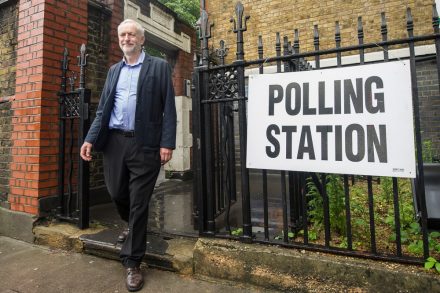
Then-Labour leader Jeremy Corbyn, who had long been a eurosceptic, came under fire for his lacklustre enthusiasm in campaigning for Remain.
Chilton said: “Jeremy Corbyn was the biggest asset the Leave campaign had, because essentially he was a Brexiteer – he was an old Bennite Brexiteer – and everyone knew it.
“When he appeared on television, no one believed it. What the party should have done, but it would never have done, would be to say the leader has got a different view to the members.”
Johnson told LabourList that Corbyn was often obstinate when working with Labour’s Remain campaign.
“We didn’t have much to do with Stronger In (the official Remain campaign), but they would help us by having days clear for us to do stuff that would not be diluted by them doing something as well. Jeremy had all these opportunities, but never took them.
“We were going to do something with the surviving Labour leaders, except Jeremy wouldn’t share a platform with Tony [Blair]. There were all these plans and he would not do it.
“He had no problem standing with existing Labour people, but it would have been more powerful if we could have done it with Gordon [Brown] and Tony.”
Despite this, Johnson was clear where the blame for the referendum result lies.
“I don’t blame Corbyn, I blame Cameron. It was absolute folly to have a referendum on Europe out of nowhere.”
‘We surrendered immigration to Leave’
For Johnson, the Remain campaign’s biggest mistake was to surrender the debate around immigration to Leave activists. In particular, he highlights the publication by the ONS of net migration figures around a month before the referendum, with net migration hitting 330,000 in 2015.
He said Labour’s Remain campaign had sought to sell the positive case for immigration and freedom of movement, but “Stronger In wouldn’t talk about it”.
“They said when the argument’s on the economy, we win. When the argument’s on immigration, Leave wins – so let’s keep the argument on the economy.
“Too late – the 330,000 wiped that away. We surrendered it [immigration] to them. We did our bit, David [Blunkett], in particular, was brilliant – but it never got the cut-through.”
When asked what he would have done differently during the campaign, Johnson said: “I would get the immigration stuff in early. We were on the back foot because the ONS published that figure. When they published it, we were kind of reacting to it, so I’d have got in a bit earlier.”
Become a friend of LabourList and join our community. Our friends support our vital non-factional work and get access to exclusive content and events.
‘Leave should never have put that figure on the side of a bus’
Among Chilton’s memories of the referendum campaign, one rally in Essex stood out.
“I was sitting next to Sir David Amess and we were going onto the stage one by one to speak. The audience had had quite a lot of beer, they were well oiled.
“In terms of the speaking order, it always went everyone, me and then Farage. I’d finished my speech, I sat down and Farage came onto the stage. All I can remember is his silhouette moving up onto the stage and speaking – this was really the moment when I thought this man one day could be a severe and terrifying threat to the Labour movement.
“The audience was what I would call a white working class, but also mixed race working class people from that part of the world. He held that audience in his hand, he was like a conductor.
“I can remember David leaning over to me and he said ‘Thank God there’s not an election tomorrow’.”
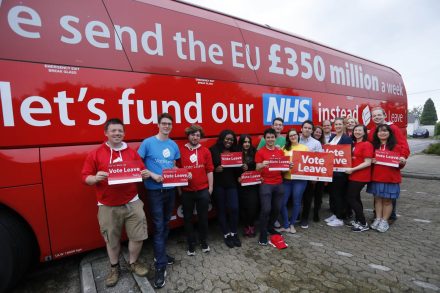 For all his criticism of “fanciful claims” made by the Remain campaign, there was one element of the Leave campaign which Chilton singled out for disapproval.
“The official Leave campaign should never have put that figure on the side of a bus. From a PR and marketing campaign, it was very clever – but actually it wasn’t about the referendum.
“It was a silly thing to do, because the way they presented it people were going to expect that we’d leave on the Thursday and on the Friday £350 million was going to land in the NHS’ lap. That was never going to happen.”
‘I anticipated we would lose the referendum’
MP for Oxford East Anneliese Dodds, who served as an MEP for the South East at the time of the Brexit referendum, said there was no point in the entire process that she believed Remain would win the referendum.
“I anticipated we would lose the referendum for two reasons. The first was I was very used to knocking on people’s doors across the South East of England and having the response from people that they didn’t like Europe. They had nothing against me personally but they didn’t like Europe, so that was the first reason why I knew from the beginning that this would be a really difficult referendum.
“Secondly, I felt those who traditionally represented the EU in debates about it within the UK tended to be presenting themselves as supporting the institutions – and for me, as a Labour Party member and activist, I never supported a set of rules and procedures. I supported the fact they had delivered more jobs, that they had brought families’ costs down.
“That was why I supported us remaining, but that argument had just not been made in Britain and, if I’m being completely honest, it wasn’t really made during the referendum either. The debate was focused again on institutions that felt as far away, if not further, than Westminster.”
Stringer, on the other hand, was confident throughout almost all the campaign that Leave would win.
“Our private polling always indicated Leave would win. It turned out to be on a false basis; it was based on relatively low turnout and the extra commitment of Leave voters to vote. It turned out both sides were committed; we just had a majority.
“I always thought we were going to win, until I was sat watching a football match and the news came through that Jo Cox had been shot. I thought that, in the way politics is sometimes completely irrational, I felt at that moment we were ruined.”
READ MORE: Kim Leadbeater reflects on life and legacy of Jo Cox
The beginnings of the ‘red wall’ schism
In the end, Britain voted by a narrow margin to Leave the European Union, with more than three million Labour voters – particularly in the North of England – splitting with the party’s official stance to vote Leave.
Johnson told LabourList that he was surprised by the result – having expected the Leave margin to be wider than it ended up being on referendum night.
Chilton sees the referendum as the origin of the schism between Labour’s traditional voters in the ‘red wall’ and the party.
“For the first time, Labour voters said to the party ‘we do not agree with your policy’ in their millions and they were able to vote Leave. They were then able to vote Tory, because once they had voted Leave they dabbled a bit, and now they’ve gone Reform.”
Stella Creasy, MP for Walthamstow and chair of the Labour Movement for Europe, said that the relatively close margin of the Scottish independence referendum should have been a “wake-up call” that traditionally progressive voters were losing connection with the principle of collaboration – and that the party was not connecting with them during the campaign.
“The whole Remain campaign was infused with the sense of the sheer arrogance of people for even questioning our membership, that nobody would be that stupid to give it up, so we made a case for the status quo – and as progressives, we should never be satisfied with the status quo until the status quo is without inequality, injustice or inequity.”
Dodds recalled returning to the European Parliament in the wake of the referendum, with many of her colleagues in the Socialists and Democrats grouping being surprised by Britain’s decision to leave – apart from one notable figure.
“Interestingly, the one person who wasn’t was Martin Schulz. He articulated one of my concerns, saying the UK had just gone through a financial crisis, people were rejecting the status quo – and therefore the referendum provided a way for people to register their discontent.”
‘Backing second referendum was the biggest mistake’
In the aftermath of the referendum result, Labour underwent a shift in policy on Brexit from an initial soft Brexit approach toward backing a second referendum by the time of the 2019 election.
All the people we interviewed for this piece, from both sides of the Brexit divide, were unanimous in their view that Labour’s support for a second referendum was a huge mistake.
Johnson said: “It was the biggest mistake. They called it a ‘people’s vote’ – who do you think voted the first time? It fed into this argument that the ruling classes are very keen to get our views, except when they get them, they just ignore them and want to do something else.”
He argued that Labour should have instead supported Theresa May’s Brexit deal, describing it as being “as close as you’re going to get to a soft Brexit reflecting a 52-48 decision”.
“It would have been tough to support Theresa May’s deal, but in a sense we would have been supporting Brussels’ deal.”
Subscribe here to our daily newsletter roundup of Labour news, analysis and comment– and follow us on TikTok, Bluesky, WhatsApp, X and Facebook. You can also write to our editor to share your thoughts on our stories and share your own. The best letters are published every Sunday.
Britain’s future with the EU
What should Britain’s relationship with Europe look like in the decade to come? Rather than calling for Britain to rejoin, a position Mayor of London Sadiq Khan has recently urged Labour to adopt, Creasy has advocated for the UK to look into adopting a Swiss-style deal to rebuild our damaged relationship with the EU.
She argued that, while jumping to rejoin is unrealistic in the short term, Switzerland’s sector-by-sector agreements with the EU have helped unlock access to parts of the single market vital to manufacturing and industry.
“I call it a salvage operation. None of that rules out any future relationship or rejoining, but it does recognise the catastrophic damage done by the way in which we left, the urgency of giving people some sense that you could actually fix some of these challenges and showing our European counterparts that we understand and appreciate we have to win back their trust.”
Chilton, on the other hand, sees Brexit as “largely settled”, comparing those wanting to rejoin to the “Japanese soldiers on the islands after World War Two, still fighting after the emperor’s declared peace”.
Instead, he argues the government ought to be doing more to take advantage of being outside of the EU and embrace Mark Carney’s idea of an “alliance of middle powers”.
“I’d like to see a Britain that is looking out to the world… looking to other countries like a resource-rich Canada, Australia, the Pacific countries and India.
“In a world where we’ve got Donald Trump, and even when he goes it’s likely that this American isolationism will continue, we need a Britain armed to the teeth and that is going to mean some very difficult choices in terms of spending.
“We have a real competitiveness problem and a real productivity problem. We should be massively trying to incentivise industry in this country. Why can’t we have a lower corporation tax for manufacturers? Why can’t we have employment incentives for manufacturers? What on earth has happened to planning reform?
“We’ve got a finite time left in government, and if people don’t feel at the end of this that they are wealthier and the country is on a path to prosperity, we’re going to be in real difficulty.”
A decade on, it is clear that scars remain within the Labour family over the divisive referendum and the legacy of the deal struck by Boris Johnson. With growing calls for Labour to pursue a closer relationship with Europe, and with new leadership heading for Number 10, the European question that the referendum sought to answer looks set to continue rumbling through Labour politics for another decade to come.
-
- SHARE: If you have anything to share that we should be looking into or publishing about this story – or any other topic involving Labour– contact us (strictly anonymously if you wish) at [email protected].
- SUBSCRIBE: Sign up to LabourList’s morning email here for the best briefing on everything Labour, every weekday morning.
- BECOME A FRIEND: If you enjoyed this, why not consider becoming a Friend of LabourList? Help sustain our journalism, and of course Friends do get benefits…
- PARTNER: If you or your organisation might be interested in partnering with us on sponsored events or projects, email [email protected].
- ADVERTISE: If your organisation would like to advertise or run sponsored pieces on LabourList‘s daily newsletter or website, contact our exclusive ad partners Total Politics at [email protected].



More from LabourList
Letters to the Editor – week ending 11th October 2026
‘Playing it safe on Europe is the riskiest thing Labour can do’
‘Jack Charlton and Labour’s rural tradition’