

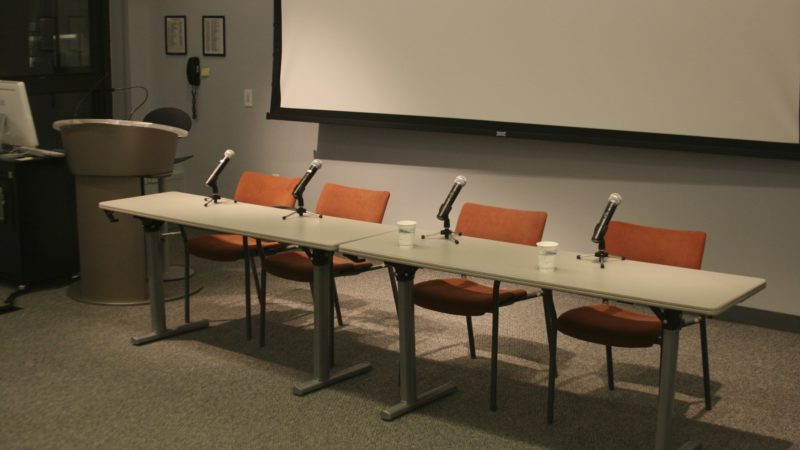

Some events I won’t be going to at Conference

September 20, 2012 2:44 pm

For the last two years I and many others have called and called again for political panels in general – and particularly those around the Labour Party Conference – to be a bit more gender balanced; to at least have one woman speaker on every topic. It really isn’t difficult to do. In the ten years or so I have been organising political events – on an extremely diverse range of topics from waste management to constitutional reform, I have never, not once, put on a panel that didn’t have a female speaker.

To fail to do so shows such a dull lack of imagination that I can’t help feeling it also shows up the paucity of intellectual rigour on offer. So imagine my dismay, as I trawled through the Labour Party Conference app and found event after event offering a stale, pale and wholly male panel.

For me the most shocking are the events discussing the future of party policy and strategy. This is something I have written about time and time and time again. I haven’t been invited to speak on it at any fringe events, but I was looking forward to going along to debate with others who had.

But I won’t be attending Progress and the Institute for Government’s discussion on “From opposition to opportunity: How can Labour develop good policy for Government” with it’s three male speakers and it’s male chair. [Update: I'm delighted to say that Progress have been in touch, and there will be an excellent female speaker: Catherine Haddon from the Institute of Government. Very happy to correct the record on this occasion and will do so for any others that are wrong.]

Neither will I be attending The Times and Populus’ event “Labour and the voters” which once again has three male speakers and a male chair. Cos it’s not like any of those voters are women, right??

You can also count me out of the Labour Democratic Network fringe and AGM (two male speakers and a male chair). Not exactly representative democracy is it?

I won’t be “reconsidering Blairism” with Policy Exchange and I won’t hearing “Talking to the Voters: Three arguments Labour must make” with Shelter and Fujitsu. I guess the concept of Blair’s babes is finally as passé as that bloody awful, patronising term.

This is just one topic. Other events that – according to the Labour Fringe App* – have no place for the ladies include several on social policy, crime, Europe, housing etc. The list is very, very long and very, very depressing.

It is also worth mentioning that I haven’t even touched on all the events where there are no female speakers, but the panel is given a semblance of balance by a female chair. That’s all very well, but we’re not here just to play nanny and nursemaid. We have opinions and thoughts of our own and should have the equity to share those – not just umpire while the men fight it out.

Things need to change. They need to change because there is a clear moral case for equity. Representation of women is slipping backwards not forwards. They are under-represented not just in politics at Westminster, but through all the channels that feed Westminster politics, the councils, the think tanks and the pressure groups.

As anyone who has read Deborah Mattinson’s excellent “Talking to a Brick Wall” will know, women voters have the same issues as male voters generally, but tend to talk about them and relate to them differently. It’s not mere tokenism to ask that women’s voices be represented on such panels but the pragmatism that recognises that connecting properly to women voters is essential to our winning the next election. If our male strategists have any sense, they’ll be as much outraged by this as I am.

Next year, Labour should take up the call not to accept any fringe advertisement that doesn’t include a female speaker. But the male speakers should also take up their share of making this change happen. Next time you’re asked to appear on a panel, ask them if any women will be involved, and make it quite clear that you will not appear without women panellists. Equality is the responsibility of all of us and vigilance from all is essential.

Shining a light on the failings of our movement is an essential first step to addressing those failures. Let us now move forward together to ensure that conference 2013 reflects our country and our values.

*All information taken from the Labour Party Conference Fringe App on 20th September 2012. If any of the mentioned panels have since added female speakers, I would be delighted to hear about it in the comments below.


  • http://about.me/natepbarker Nate Barker

    Well said, Emma! I’m involved with a brand new group that’s hosting our first fringe event, (Labour for a Republic), and even though we’re new and tackling an issue that may not have the drawing power of some of the events you’ve talked about, we haven’t had any difficulty in getting female speakers. I can’t help but think that events without female representation are doing so through a lack of commitment to ensuring a balanced panel.

    (incidentally, info on our event http://www.labourforarepublic.org.uk/events/fringe-debate-at-party-conference/)

  • Winston_from_the_Ministry

    This would have more weight if you could, perhaps, put up some examples of ideal female candidates for these panels that would be better (on merit) than the existing male panellists.

    • Brumanuensis

      I can see that some people still share Dr Johnson’s views on women preaching / being present on discussion panels.

      • Winston_from_the_Ministry

        Wind your neck in Brum.  I’m not saying she’s wrong, just saying it would be a much better article if it had been thought about a bit more.

        • http://twitter.com/Cllr_Roxsie Roxanne Ellis

          Because it is always the responsibility of women to find talented and articulate women to be on panels? The choice of panels aren’t usually based on merit so much as who is the most vocal. In many cases those who are the most vocal and promote themselves the most are men.  Those who create the panels are also often male and don’t think that they are excluding women, it’s often not malicious just not something they think about. 

      • http://twitter.com/RF_McCarthy Roger McCarthy

         Not me – my issue is not with the complaint that there are too few women on panels or even with the specific solutions Emma offers to that problem – but that the crisis of representation goes far, far deeper than gender imbalance on the panels at what are satellite meetings around a largely ritual event.

      • http://twitter.com/RF_McCarthy Roger McCarthy

         Not me – my issue is not with the complaint that there are too few women on panels or even with the specific solutions Emma offers to that problem – but that the crisis of representation goes far, far deeper than gender imbalance on the panels at what are satellite meetings around a largely ritual event.

      • http://twitter.com/RF_McCarthy Roger McCarthy

         Not me – my issue is not with the complaint that there are too few women on panels or even with the specific solutions Emma offers to that problem – but that the crisis of representation goes far, far deeper than gender imbalance on the panels at what are satellite meetings around a largely ritual event.

      • http://twitter.com/RF_McCarthy Roger McCarthy

         Not me – my issue is not with the complaint that there are too few women on panels or even with the specific solutions Emma offers to that problem – but that the crisis of representation goes far, far deeper than gender imbalance on the panels at what are satellite meetings around a largely ritual event.

      • http://twitter.com/RF_McCarthy Roger McCarthy

         Not me – my issue is not with the complaint that there are too few women on panels or even with the specific solutions Emma offers to that problem – but that the crisis of representation goes far, far deeper than gender imbalance on the panels at what are satellite meetings around a largely ritual event.

    • emilypunkhurst

      I’m confused. Is there some guidebook of men that are versed to speak on certain subjects?  Would undertaking the same process to locate male speakers, but taking a punt on researching a woman in the same field, not be an adequate response to this. Call me resourceful if you like…

  • http://twitter.com/robertsjonathan Jonathan Roberts

    It’s funny because I won’t be going to any of the events at Labour’s National Women’s Conference.  Even if I wanted to, I wouldn’t be allowed to.  You see, men are actually banned from such events.   Banned, Emma.

    There’s also a woman’s reception, a fringe on domestic violence against women and on the impact of the austerity on women.  There’s an event ‘celebrating’ the women in the party, and another event on the impact of worker rights reforms on women.  Why haven’t you mentioned any of this in your article?

    Despite the abundance of events focusing on women, there is not, however, a single fringe event solely regarding men’s issues – such as the fact that prostate cancer research gets half the funding of breast cancer, or that men are 4 times as likely to kill themselves as women.  Or that boys are more likely to underperform at school, or indeed die earlier than women.  I assume this is because nobody cares, perhaps everyone was too busy looking forward to ‘celebrating women’ to be interested in tackling these genuine problems.

    I’m sorry you feel so inconvenienced, but something tells me you’ll be just fine.

    • Dave Postles

       There seem to be here sessions of general interest and sessions of special interest.  For sessions of general interest, then diversity of representation would seem important.  For special interest sessions, it’s important to have representatives of those interests.  If men wish to have sessions on those special interests, then they should perhaps organize them.  OTOH, it may be a question of nose/spite/face not to attend the sessions on general interest, gritting one’s teeth, to make other voices heard from the floor.  Nate Barker has it about right, I think.  I’m actually referring in general to any party conference, not just Labour. 

  • http://www.facebook.com/stuart.wheeler.351 Stuart Wheeler

    My immediate thought I have to admit was “uh oh here we go again” but by the time I finished reading the article I had been won over, an inclusive Party such as ours must ensure that all shades of party opinion and all sections are reflected in discussion and policy making. My own constituency has experience of all women shortlisting which to say the least has not been popular, but leaving that aside how can a Party which has an all women shorlist policy fail to recognise the requirement to have women speakers and panellists on all party forums. Good luck with your campaign Emma

  • http://twitter.com/RF_McCarthy Roger McCarthy

    To boycott a meeting because a panel of three are all men is just preposterous – normal statistical variances would produce such panels even if the class of people qualified and willing to appear on them was evenly divided.

    And all those panels are ‘stale and pale’ because they are male?

    This is genuinely insulting to comrades who actually had no choice about which genitalia they were born with and who are giving up their time.

    As for Deborah Mattinson she is not a lone feminist siren – she was a significant figure in the New Labour clique that utterly dominated the party for 15 years and at the end of it – well you’ve just described how all that female-friendly re-branding and diversity-monitoring and all-women short-listing hasn’t worked in that the activist cadre who populate fringe panels remain so disproportionately male.

    And the freakish wierdo males obsessing over process at the 1980s party meetings Mattison so condescendingly describes in her book did so because back then we were still a democratic party and those processes still made happen in the real world and it was vitally important that we got them right.

    If is almost unimaginable now but when I first joined the party in the 1970s any member could move a motion at a branch which could make its way through conference into the party programme and the election manifesto and change the lives of millions.

    So damn right we were obsessed with the processes – that to to say the rules that every complex democratic organisation needs to function – that allowed that to happen.

    But destroying that democracy and turning us into a cheerleading claque of shiny happy people the Blairs and Goulds and Mattinsons  didn’t even produce real diversity – as the people that once Labour served became even more alienated from the party and even less likely to join us, attend meetings and sit on those bloody panels.

    Restore actual democratic powers to Conference and CLPs and branches and let people believe that their vote and their voices matter and you will get more people joining up and becoming active – or we can carry on as we are but carefully re-arrange the deckchairs at the meetings so that we just look more representative.

    • http://twitter.com/RF_McCarthy Roger McCarthy

       Emma accused some of her commenters of misogyny on twitter which presumably includes this reply.

      This does concern me as yes looking at the above I have gone off on a classic ‘and another thing’ rant about something that bugs me rather than really address her argument.

      I also admit that my recollection of the good old days when we had a conference that actually made things happen and where fringe meetings were not the most interesting thing going on around the venue is seriously rose-tinted.

      So yes, a number of panels having zero women on them is clearly a sign of a real gender imbalance amongst the activists who select and sit on panels and making them actually address this issue in advance does make sense.

      But refusing to endorse (i.e. advertise) events that fail to meet a quota does seem to me like overkill.

      Not all panels have much choice in speakers – a small organisation may genuinely know only a couple of people who can give speeches and who can make the event and yes these may indeed happen to be male.

      What to me would seem to be a more effective approach is to attend that meeting and make a point of directly asking why there are no women on the panel – and if Emma doesn’t think it is presumptuous coming from a man I will promise to do this myself at the first such fringe meeting I attend.

      In one or two cases you might even get given a valid reason – and in the others the awkwardness of having to answer that question might well have a more salutory effect on future behaviour than berating them in a blog which the organisers probably do not even read. 

      And let’s get some actual numbers (OK difficult if you don’t have a programme – but I get mine tomorrow and will happily do a table listing all advertised events and speakers apparent gender and share it here).

    • emilypunkhurst

      I read a wonderful quote once about fighting for representation of minority groups. It said something like, “I realised we had spent so long fighting for a seat at the table, we had never stopped to consider what the table should look like” – wish I could remember who it was from.

  • emilypunkhurst

    By coming up with a list of women because people who put panels together don’t think about the need to include them? Hmm…

  • AlanGiles

     Jon.  May I say I agree with virtually every word you have written here.

    Even in 2012, men are still expected to get on with it, and as you so rightly say, it seems to be ignored that middle aged men are now the highest risk group for suicide.

  • Winston_from_the_Ministry

    Yes, you are.

    Surely “taking a punt” on a woman is a bit patronising. Surely there are some obvious candidates? If not, then the indignation is surely misplaced…

  • http://twitter.com/RF_McCarthy Roger McCarthy

    You have one plausible point on prostate cancer: while the age standardised incidence is 106 per 100,000 compared to 124 per 100,000 for breast cancer this difference is negated by the lower survival rates for prostate cancers.

    And while that figure of breast cancer getting 4 times the funding of prostate cancer is endlessly broadcast around by male victimhood groups it is actually hard to substantiate  – looking at UK data for instance in 2006 breast cancer got 18.8% of research funding while prostate cancer got 7.9% – a big difference but not 400%.

    However decisions on how to allocate research funding are not driven by incidence and mortality rates alone but by what is scientifically feasible and it may well be (my not being an Oncologist I have no more idea than you do) that there is simply more that can be done with breast than prostate cancers. 

    In any case I’d be very surprised indeed if either the boards making cancer research funding decisions or the people doing it are predominantly female – these choices are like most important decisions in our society made by men (and maybe there is even something noble in that here at least we may genuinely be putting women first).

    On suicide your figures are again exaggerated: 2010 statistics show that men are three not four times more likely to kill themselves than women:

    http://www.ons.gov.uk/ons/dcp171778_254113.pdf

    Although finding hard data is problematic I’ve read several studies suggesting that suicide attempts are considerably more balanced between males and females than deaths are – it is just that men are genuinely better at killing themselves than women as they choose quicker, more violent and irrevocable methods and are less likely to change their minds during the act.

    What we do know is that for men who do succeed in killing themselves hanging is by far the most popular method chosen – while for women it is a drug overdose – and clearly it is much easier to change your mind and call 999 when you’ve just taken a bottle of paracetamol than when you are hanging from a home-made noose.

    Similarly while surprisingly few suicides involve the use of firearms and sharp objects it is generally men who make that final choice – and the same applies to locking yourself in a car with a tube connected to the exhaust.  

    Anyway if you have a solution to the problem of male suicide all of us who’ve had our lives devastated by losing a friend or relative this way would just love to hear it.

    Boys underperforming at school is just the consequence of their having recently stopped overperforming – as they did for so many decades when the girls underperformance was rarely considered an issue.

    And everyone who knows classrooms will tell you that the failure of so many boys is a cultural and behavioural problem for which there is no easy fix (or at least none that Guardian-reading liberals or choice- and privatisation-obsessed conservatives will accept).

    Men dying earlier than women? – again that is largely down to the sh*t we eat and the mind-bogglingly stupid stuff we do and is hardly going to be resolved by a fringe meeting proclaiming our victimhood.

  • Carolekins

    I agree, Emma, it’s shocking and indeed incredible when there have been at least some efforts from the party in the past.  Why compound the problem now when the Tories are more male than ever?

  • http://twitter.com/RF_McCarthy Roger McCarthy

    Assuming anyone else is still following this thread I did ask where are the numbers and having now got my conference pack can provide some.

    As there are 400 events there is no way I am going to analyse them all but taking the first 40 and omitting anything that looks like a reception I get  118 male to 42 female panel speakers or a 74% male dominance.

    (of course I am going entirely by names and using only the info in the conference magazine listing which will be somewhat out of date)

    Of all these 40 meetings only one has zero male speakers and 15 (37.5%) have zero female speakers.

    I also get the impression that corporate-sponsored events (of which there are still a surprising number) are more likely to have all-male panels than the purely political ones.

    So assuming that the first 40 meetings are a representative sample of the 400 fringe events Emma should be able to strike as many as 150 off her list….

    If anyone (Emma?) does want to make an issue of this and is willing to add more data I’ve saved it in google docs:
    at https://docs.google.com/open?id=0B7M9tEwN6qsJMU9xM0pmbnZORGM

  • http://www.facebook.com/people/Eleanor-Firman/608124178 Eleanor Firman

    hi Emma,
    Labour Land Campaign has re-arranged our speakers for The Economics of Education and the Education of Economists, 12.45pm Cross St Chapel Monday !st October.
    I will now be speaking alongside William Dixon (Senior Lecturer in Economics, London Metropolitan Business School) and Martin Johnson (Deputy General Secretary ATL).  Kelvin Hopkins MP Luton North will be in the Chair.

    Eleanor Firman
    Labour Land Campaign Research Officer

Latest

  • Comment Should people be asked if they are party supporters when they register to vote?

    Should people be asked if they are party supporters when they register to vote?

    Chris Clark and Rav Seeruthun on a small change that if adopted, would free activists to spend more time on community work Every year at party conferences we hear professional politicians eulogise hard-working party volunteers. And there’s no activity more often evoked than that of ‘knocking on doors’. It’s a common delusion that the purpose of doorstep canvassing is to ‘persuade’ voters. Having taken part in our fair share of Labour canvassing sessions, we’ve both had the dispiriting experience of [...]

    Read more →
  • Europe Featured You can always rely on the Conservatives to ignore the public when it comes to Europe

    You can always rely on the Conservatives to ignore the public when it comes to Europe

    Europe is not often the issue which comes top of people’s concerns on the doorstep. Nor do opinion polls suggest that Europe is a priority for voters when compared to issues like the economy or jobs. But you can always rely on the Conservatives to ignore the public when it comes to Europe. This week saw over a hundred Conservative MPs rebel and vote against their own Queens Speech. They were angry that it hadn’t included a bill which would [...]

    Read more →
  • News Seats and Selections Vicky Foxcroft selected as Labour’s PPC for Lewisham Deptford

    Vicky Foxcroft selected as Labour’s PPC for Lewisham Deptford

    Vicky Foxcroft has been selected by Lewisham Deptford CLP as the party’s candidate for 2015 at a selection meeting this afternoon. Here’s a brief biography: Vicky grew up in the North West in a single parent household, and was the first person in her family to go to university. She has held many positions in the party including Chair of Labour Students, has sat on the National Policy Forum and is currently a local councillor and is Chair of Lewisham [...]

    Read more →
  • Comment Labour’s future schools policy: why accountability matters

    Labour’s future schools policy: why accountability matters

    Stephen Twigg, Labour’s Shadow Education Secretary is one of the more thoughtful and pragmatic individuals to hold this vitally important brief for some time. To his credit Stephen has been out and about these past two years listening to pupils, teachers, parents and governors and finding out more about the challenges they face on a day-to-day basis. In addition Stephen has been looking closely at some local, regional, national and international programmes that have had a demonstrable impact in raising [...]

    Read more →
  • News Seats and Selections Falkirk selection process suspended by the party

    Falkirk selection process suspended by the party

    The Labour Party have this afternoon suspended the selection process for Falkirk, after concerns were raised about “membership recruitment”. We understand that Ed Miliband was “keen to act swiftly” as the selection process was due to formally begin on Sunday. An officer of the party – yet to be confirmed – will investigate. A Labour spokesperson told us this afternoon: “We have suspended the start of the selection process of the Falkirk parliamentary seat. Concerns have been raised about membership [...]

    Read more →