

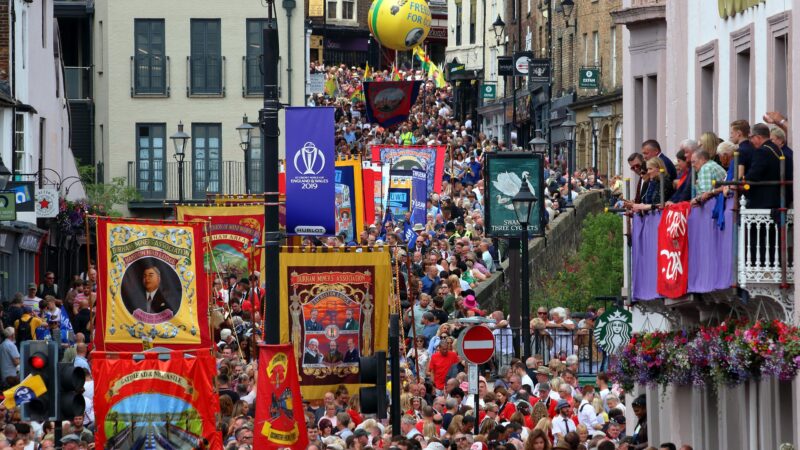

The Durham Miners’ Gala has always been more than a celebration of mining heritage. It is a reminder of what working people can achieve when they organise together — and a warning about what happens when the labour movement becomes divided.
Mining communities helped build modern Britain. Not only providing the raw materials for the industrial revolution but they also built movements for social provision: delivering decent housing, healthcare, education, libraries and culture. The mining villages that fuelled the Industrial Revolution understood that solidarity was not an abstract principle; it was built through not just industrial but fundamentally political struggles.
For example, this year marks the centenary of the General Strike, when almost two million workers from the pits, railways, docks, steelworks and printworks stood together against longer hours and lower wages. It ended in defeat, in part because the labour movement was divided. Working people paid the price through falling living standards, unemployment and hardship.
READ MORE: ‘A century of keeping Labour true to working people – and the work continues’
That lesson has echoed throughout our history. It was forty years ago, during the miners’ strike, Margaret Thatcher’s government set out to close pits as part of her mission to weaken trade unions and sell off public assets.
We know the consequences. Jobs disappeared, communities were hollowed out and wealth flowed upwards.
But remembering our history is only meaningful if it shapes the future – and that politics of division has not disappeared. Britain now has a Labour government but division is not only being advanced by the Conservatives, but also by Reform and others on the right who seek to turn economic insecurity into resentment against those with the least power
Labour’s task must be to challenge it, not to accept it as the current government has too often done, most notably on migration, where its has followed the right rather than provide a leadership in defence of migrants delivering vital services, particularly in health and social care, and don’t deserve the hostile agenda of restricting earned citizenship.
The next phase of Labour government must be about delivering a Labour agenda for a genuine change in people’s lives. A new Labour leadership has an opportunity to reset the relationship between government and working people — but it will only succeed if people feel the difference in their pay packets, their bills and their public services.
The previous Labour leadership often spoke about the need for change. It did not convince communities they were delivering it. The challenge now is to do so.
Become a friend of LabourList and join our community. Our friends support our vital non-factional work and get access to exclusive content and events.
The Employment Rights Act was an important step forward. It was a privilege to work alongside trade unions and campaigners in developing the New Deal for Working People. The final legislation did not deliver everything that many of us wanted, but it strengthened workplace rights and began reversing years of anti-union legislation.
Now we must go further. Insecure work, low pay and weak bargaining power remain major challenges. A modern Labour government should be ambitious about empowering workers and strengthening trade unions.
There have also been important steps in addition to employment rights, including renters’ rights, Great British Energy and GB Rail. But these must be the beginning of a wider programme of reform, not the end.
Working people need to feel that politics is delivering for them. Our communities have got to feel the benefit of Labour being in power. That means fair pay for teachers, nurses, paramedics, civil servants, firefighters, cleaners, security workers and millions of others whose wages were held down for years.
It also means ending the scandal of essential services being run primarily for private profit rather than public good.
People should not be forced to heat their homes or run essential appliances through energy bills which are unfairly inflated to pay excessive profits. Water companies should not be rewarding shareholders while rivers and seas are polluted. Public services should serve the public.
That means considering provision of energy and water under national public corporations, housing and transport under combined authorities, and care and local services through public providers.
The lesson of the miners’ movement is that communities are strongest when people have power: power at work, power in their communities and power over the essential services on which they depend.
The task for Labour now is to put that principle back at the heart of government. The future of our movement depends on it.
Subscribe here to our daily newsletter roundup of Labour news, analysis and comment– and follow us on TikTok, Bluesky, WhatsApp, X and Facebook. You can also write to our editor to share your thoughts on our stories and share your own. The best letters are published every Sunday.
-
- SHARE: If you have anything to share that we should be looking into or publishing about this story – or any other topic involving Labour– contact us (strictly anonymously if you wish) at [email protected].
- SUBSCRIBE: Sign up to LabourList’s morning email here for the best briefing on everything Labour, every weekday morning.
- BECOME A FRIEND: If you enjoyed this, why not consider becoming a Friend of LabourList? Help sustain our journalism, and of course Friends do get benefits…
- PARTNER: If you or your organisation might be interested in partnering with us on sponsored events or projects, email [email protected].
- ADVERTISE: If your organisation would like to advertise or run sponsored pieces on LabourList‘s daily newsletter or website, contact our exclusive ad partners Total Politics at [email protected].



More from LabourList
Good growth in every postcode 21st October 2026
‘Labour must put culture at the heart of their youth mental health plan’
‘The Thames Valley is driving growth. Devolution can turbocharge it.’