

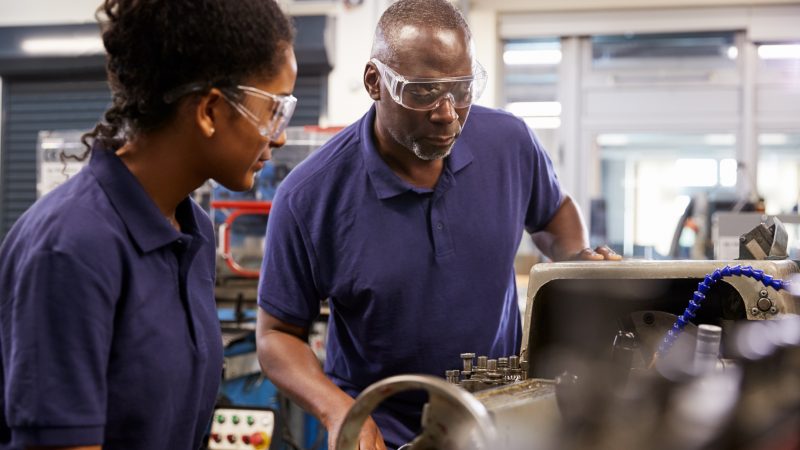

Andy Burnham’s arrival in Number 10 will present an opportunity to transform not just our economy but the skills and training that underpins it. One of the most welcome statements by Labour’s next likely leader is his commitment to rewiring our education system, so that technical and university learning sit as equal partners in the opportunities available to our next generation.
Apprenticeships could be the ‘white heat’ of Burnham’s Britain, sitting as they do at the foundation of many of Labour’s missions to rebuild the country.
We have been talking about why an apprenticeship should be viewed as equal to a degree for most of my adult life. To me, it is obvious that apprenticeships deliver work-ready young people with technical skills and experience, and that is every bit as useful as graduates with academic training and analytical skills. Yet too often governments have ducked the challenge. This is about culture change as much as it is public policy. Ending our national obsession with university at the expense of technical skills is not only beneficial to young people, but to our wider society and economy.
In his book Head North: A Rallying Cry for a More Equal Britain, co-authored with Steve Rotherham, Burnham says that the education system: “…is wired primarily to support the needs of the university route and can actually be a generator of social division rather than promoting the more equal society we wish to see.”
READ MORE: ‘‘Let’s make devolution work’
In industrial, blue-collar cities like Peterborough this wiring has left too many young people behind. It has damaged the social contract whereby working hard meant parents could ensure their children had a better shot at life. Labour’s blunt target of 50% of young people going to university was dressed in good intent but, in reality, skewed the system further towards traditional higher education at the expense of technical education. But this wasn’t the original sin. The divide started a generation before when our economic model became trickle-down and de-industrialisation took hold as a legitimate national aim. Britain needs to get back to making things again and valuing the jobs that build the homes, services, technologies and resilience we need. We have turned away from the clear examples of places like Sweden and Germany where their dual system values academic and technical education.
In his recent speech calling for ‘good growth in every British postcode’, Burnham went further:
“The days of a school system configured entirely around the university route will be brought to an end. University is great for those who want it – but when are we going to focus on the life chances of those kids who want something different? When? The country hasn’t done that for a long, long time.”
Become a friend of LabourList and join our community. Our friends support our vital non-factional work and get access to exclusive content and events.
As someone who has been champing at the bit for this my entire adult life, it is music to my ears. We now need an approach to technical education as ambitious as the conversation on devolution. I have been arguing for a national renaissance of apprenticeships. Every young person must be able to access the skills, social capital, experiences, and confidence currently enjoyed only by a minority. When we read Alan Milburn’s landmark report Young People and Work, we see not only the moral imperative, but also the case for national survival. The fact is that unless we rescue the million young people currently not working or learning, we are collectively sunk. It’s why Pat McFadden’s work on the Youth Guarantee is both valuable and important.
The missing ingredient is not political, but cultural. Unless we remove the crushing snobbery that degrades apprenticeships and technical education, we will never prosper. This bias takes many forms, from university-educated policy-makers, advisers, officials, and even ministers, to wider society. We should celebrate the achievements of apprentices just as loudly and proudly as graduates. Further education colleges should be valued like universities and funded to the right level. Unless we make this cultural shift, we will never make progress. We are perfectly capable, as a society, of shifting attitudes. This willingness to change must apply to apprenticeships and technical education.
There are signs of hope, as young people recognise that certain trades are well-paid and AI-proof, compared to certain types of degree which no longer guarantee a high-flying job and come with eye-watering debts. Now, we need to accelerate the shift.
Subscribe here to our daily newsletter roundup of Labour news, analysis and comment– and follow us on TikTok, Bluesky, WhatsApp, X and Facebook. You can also write to our editor to share your thoughts on our stories and share your own. The best letters are published every Sunday.
-
- SHARE: If you have anything to share that we should be looking into or publishing about this story – or any other topic involving Labour– contact us (strictly anonymously if you wish) at [email protected].
- SUBSCRIBE: Sign up to LabourList’s morning email here for the best briefing on everything Labour, every weekday morning.
- BECOME A FRIEND: If you enjoyed this, why not consider becoming a Friend of LabourList? Help sustain our journalism, and of course Friends do get benefits…
- PARTNER: If you or your organisation might be interested in partnering with us on sponsored events or projects, email [email protected].
- ADVERTISE: If your organisation would like to advertise or run sponsored pieces on LabourList‘s daily newsletter or website, contact our exclusive ad partners Total Politics at [email protected].



More from LabourList
Good growth in every postcode 21st October 2026
‘Labour must put culture at the heart of their youth mental health plan’
‘The Thames Valley is driving growth. Devolution can turbocharge it.’